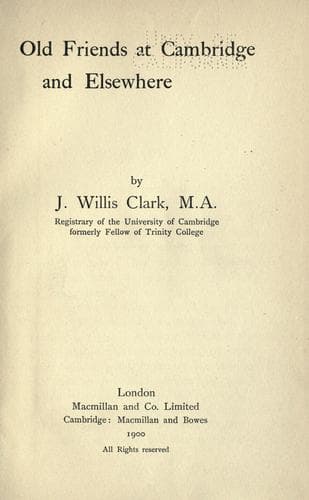
Old Friends at Cambridge and ElsewhereClark, John Willis
History
Old Friends at Cambridge and Elsewhere
Clark, John Willis
University of Cambridge -- History
the result arrived at by the light of subsequent events, it is natural
for those who, like his biographer and ourselves, are strongly
prepossessed in Palmer’s favour, to regret that he was unsuccessful; and
we are delighted to find Mr Besant asserting, as he does, that
University distinctions ought to be given, _ceteris paribus_, to
University men. But if we try to put ourselves in the position of the
electors, and survey the two candidates as they surveyed them, there is,
we feel bound to assert, ample justification for the selection they
made, having regard to the particular post to be filled at that time.
They had, in fact, to choose between a tried and an untried man. Dr
Wright was known to have received a regular education in Oriental
languages in Germany and in Holland, and to be thought highly of by the
most competent judges in those countries. He had given proof of sound
scholarship in various publications, and it was considered by several
scholars in the University that the studies to which he had given
special attention, viz.—Syriac, Samaritan, Ethiopic, and the Semitic
group of languages generally—would be specially useful there. He had
held a Professorship in Trinity College, Dublin, where he had been
distinguished as a teacher; he was personally known in Cambridge, not
merely to Dr Phillips, but to the University at large, at whose hands he
had received the honorary degree of Doctor of Law in 1868. Moreover, he
was already an honorary Fellow of Queens’ College, and therefore it was
not strange that a Society which had already gone so far should signify
to him their intention of proceeding a step further, in the event of his
consenting to come and reside at Cambridge as a Professor. He was
accordingly elected Fellow January 5, 1871[97].
Palmer, on the other hand, had submitted to the electors testimonials
which testified to his wonderful knowledge of Hindustani, Persian, and
Arabic as spoken languages; he was known to have given special attention
to the languages of India; he had catalogued the Oriental MSS. in the
Libraries of the University, of King’s College, and of Trinity College;
he had translated Moore’s _Paradise and the Peri_ into Arabic verse; and
he had published a short treatise on the Sufistic and Unitarian
Theosophy of the Persians. But here the direct evidence of his
acquirements ceased; and it is at this point that the date of the
election becomes material. None of his more important works had as yet
appeared. The official Report of his journeys in the East was not
published until January 1871; and the preface to his _Desert of the
Exodus_ is
dated June of the same year[98]. The Heads, therefore, could not know
that he ‘had relied on his knowledge of the language for safety in a
dangerous expedition.’
Public-domain text, read in full here on John Shaqi.
Reviews
Reviews
No reviews yet
Be the first to share your thoughts on this work.
Elsewhere in the archive
Join the Discussion
Join the discussion
Sign in to leave a comment or review.
Sign InorCreate an account