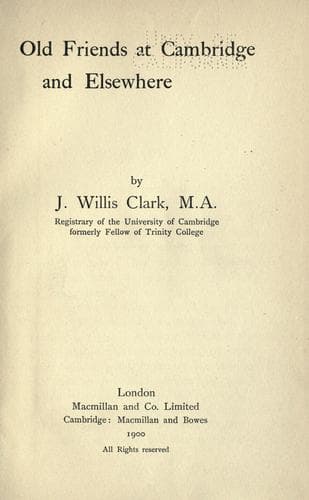
Old Friends at Cambridge and ElsewhereClark, John Willis
History
Old Friends at Cambridge and Elsewhere
Clark, John Willis
University of Cambridge -- History
it, was quite subsidiary to the former, though perhaps, as a matter of
policy, it was occasionally made prominent, in order to disarm
suspicion. That much more important business than buying camels was
intended is also proved by a letter from Palmer to Admiral Hewett, in
which he said that ‘it would be most desirable that an officer of her
Majesty’s Navy should accompany me on my journey to the Desert, as a
guarantee that I am acting on the part of her Majesty’s
Government[106].’
It must now be mentioned that on Palmer’s first journey, when staying in
the camp of Sheikh Misleh, he had been introduced by him to a man of
about seventy years of age, of commanding stature, and haughty,
peremptory manner, named Meter ibn Sofieh. This man Misleh had
represented to be the Sheikh of the Lehewat tribe, occupying all the
country east of Suez. This was not true. Meter was not a sheikh of the
Lehewats, and the Lehewats as a tribe do not live east of Suez, but on
the south border of Palestine. Meter was a Lehewat, but he was simply
the head of a family who had left the tribe, and taken up their abode
near Suez, where they had collected together two or three other
families, who called themselves the Sofieh Tribe, but had no power or
influence. Palmer, however, believed Meter’s story about himself, called
him his friend, and trusted him implicitly. It was Meter whom he sent
into Suez from Misleh’s camp to fetch his letters; Meter who conducted
him thence to the place called ‘The Wells of Moses’ between July 27 and
July 31; Meter with whom he corresponded respecting his second journey;
and there is little doubt that it was Meter who betrayed him.
In the Report which Palmer addressed to the Admiralty on August 1 he
stated that when he started on his second journey a company of 300 or
400 Bedouin should go with him, ‘for the sake of effect.’ Most
unfortunately, this precaution was not taken. On August 7, Meter,
accompanied by his nephew, Salameh ibn Ayed, came to Moses’ Wells, and
asked Mr Zahr, one of the native Christians who reside there, to read a
letter which he had received from Palmer. The letter, signed ‘Abdullah,’
contained a request that Meter would bring down one hundred camels and
twenty armed men. Meter then crossed over to Suez by water, Mr Zahr’s
son going with him, saw Palmer, who did not, so far as we know, express
surprise that he came without men or camels, and in the evening was
presented to Consul West and Admiral Hewett, from whom he received a
naval officer’s sword, as a mark of confidence and respect. This sword
Meter subsequently gave secretly to Mr Zahr’s son to take care of for
him, saying that he was going to the Desert with some English gentlemen,
and was afraid that the Bedouin might kill him if they saw him with a
sword, as they were not quiet at that time. After the murder, Mr Zahr’s
son brought the sword to the English Consul, and told the above story.
Public-domain text, read in full here on John Shaqi.
Reviews
Reviews
No reviews yet
Be the first to share your thoughts on this work.
Elsewhere in the archive
Join the Discussion
Join the discussion
Sign in to leave a comment or review.
Sign InorCreate an account