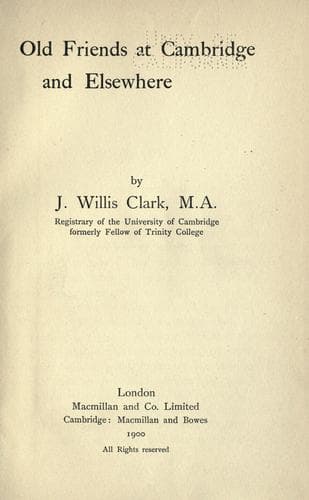
Old Friends at Cambridge and ElsewhereClark, John Willis
History
Old Friends at Cambridge and Elsewhere
Clark, John Willis
University of Cambridge -- History
In the same spirit of discovery he applied himself to the study of
Chaucer. Silently and secretly, as was his wont, he examined all the
manuscripts within his reach, and then set to work to determine (1) what
was Chaucer’s own work; (2) what is the real order of the _Canterbury
Tales_. In the course of his researches it occurred to him that the
rhymes used would prove a test of what was Chaucer’s and what was not.
Without assistance from any one he wrote out a complete rhyme-list—an
astonishing labour for an individual, when it is remembered that the
_Tales_ contain some eight thousand lines, every one of which must have
been registered twice, and many three or four times. The labour,
however, was not thrown away. The rhymes employed turned out to be a
true test, and Mr Bradshaw was enabled to publish in 1867 ‘The Skeleton
of Chaucer’s _Canterbury Tales_: an attempt to distinguish the several
Fragments of the Work as left by the Author.’ We regret to say that this
pamphlet of fifty-four octavo pages is all that the world is ever likely
to see of this splendid piece of work. With characteristic
self-depreciation he says, in a note appended in 1871, ‘Mr Furnivall’s
labours have put far out of date any work that I have ever done upon
this subject’; but it is gratifying to turn to Mr Furnivall, and read,
‘There is only one man in the world, I believe, who thoroughly
understands this subject, Mr Henry Bradshaw.’ He welcomed Mr Furnivall
with habitual generosity, and placed in his hands, without reserve, all
that he had got ready for the edition of Chaucer which he at one time
intended to publish himself. Publication, however, was what he could
rarely be persuaded to attempt. It was not criticism that he feared; but
he had set up in his own mind such a lofty standard of excellence that
he could not bear to abandon a piece of work while it was yet possible
to add some trifling detail, or to correct some imperfection which his
own fastidious taste would alone have been able to detect. It is sad to
think how much has perished with him. His excellent memory enabled him
to dispense with notes to a far greater extent than most persons, and
those which he did put down were written on a system to which we fear it
will be impossible now to find the key. What he actually published
amounts to very little. When we have mentioned eight short octavo
pamphlets, which he called ‘Memoranda’; a few papers printed by the
Cambridge Antiquarian Society; some communications to _Notes and
Queries_ and other periodicals; and an admirable edition of the new
_Statutes for the University of Cambridge, and for the Colleges within
it_, we fear that the list is complete. He had made important
discoveries respecting the old Breton language in connexion with the
early collection of canons known as the _Hibernensis_, and had collected
materials for a Breton glossary which would have placed him in the first
rank of philologers; he had worked at Irish literature with the special
Public-domain text, read in full here on John Shaqi.
Reviews
Reviews
No reviews yet
Be the first to share your thoughts on this work.
Elsewhere in the archive
Join the Discussion
Join the discussion
Sign in to leave a comment or review.
Sign InorCreate an account