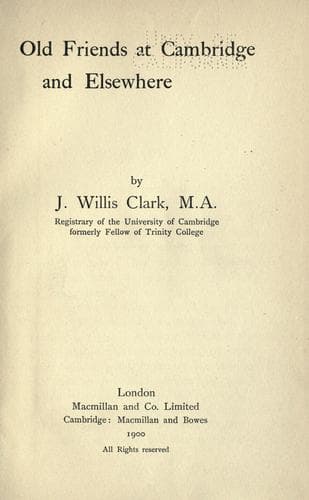
Old Friends at Cambridge and ElsewhereClark, John Willis
History
Old Friends at Cambridge and Elsewhere
Clark, John Willis
University of Cambridge -- History
To take a metaphor from our representative system, Owen was the member
for biological science in the parliament of letters for nearly half a
century. And yet he was not a great thinker; his name is not associated
with any far-reaching generalization, or any theory fruitful of wide
results. As a comparative anatomist, and as a paleontologist, he did
plenty of good and solid work. But these pursuits are most commonly
those of a recluse. The man who engages in them must be content, as a
general rule, with the four walls of his laboratory, and the applause of
a small circle of experts. Not so Professor Owen, as he was most
commonly designated, even after he had received knighthood. He contrived
to lead an essentially public life; to be seen everywhere; to have his
last paper talked about in fashionable drawing-rooms quite as much as in
learned societies. How did he effect this? We think that the answer to
our question is to be found—first, in the general eagerness for
scientific instruction which was one of the characteristics of the age
in which he lived; and, secondly, in his own many-sidedness. He was by
no means one of those authors ‘who are all author,’ against whom Byron
launched some of his most brilliant sarcasms. He was a man of science;
but he was also a polished gentleman of varied accomplishments.
It is to be regretted that such a man has not found a biographer more
competent than his grandson and namesake; but the reader who reaches the
end of the second volume will be rewarded by a masterly essay by Mr
Huxley on Owen’s place in science. This is a remarkable composition; not
merely for what it says, but for what it does not say; and we recommend
those who would understand it thoroughly, not merely to read it more
than once, but to cultivate the useful art of reading between the lines.
Of a very different nature to _The Life of Owen_ is the article which
Sir W. H. Flower has contributed to the _Dictionary of National
Biography_. It is of necessity much compressed, but it contains all that
is really essential for the proper comprehension of Owen’s scientific
career, and praise and blame are meted out with calm impartiality. For
ourselves, we have a sincere admiration for Owen, but an admiration
which does not exclude a readiness to admit that he had defects. In what
we are about to say we do not propose to draw a fancy portrait. If we
nothing extenuate, we shall set down naught in malice. In a word, we
shall try to present him as he was, not as he might have been.
* * * * *
Public-domain text, read in full here on John Shaqi.
Reviews
Reviews
No reviews yet
Be the first to share your thoughts on this work.
Elsewhere in the archive
Join the Discussion
Join the discussion
Sign in to leave a comment or review.
Sign InorCreate an account