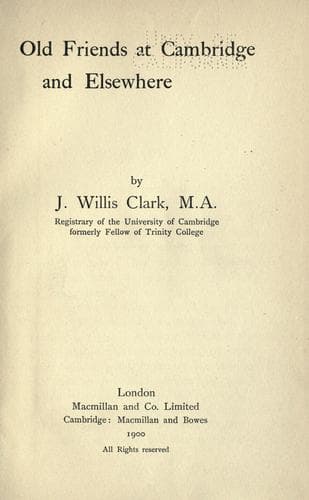
Old Friends at Cambridge and ElsewhereClark, John Willis
History
Old Friends at Cambridge and Elsewhere
Clark, John Willis
University of Cambridge -- History
It is much to be regretted that one who worked at his own subjects with
such untiring zeal should have left behind him almost nothing to
perpetuate his name with the great mass of the people. Mr Huxley remarks
that, ‘whether we consider the quantity or the quality of the work done,
or the wide range of his labours, I doubt if, in the long annals of
anatomy, more is to be placed to the credit of any single worker’ (ii.
306); but he presently adds this caution: ‘Obvious as are the merits of
Owen’s anatomical work to every expert, it is necessary to be an expert
to discern them’ (ii. 332). He gave popular lectures, but they were not
printed[123]; he wrote what he intended to be a work for all time, but
it has faded out of recollection, and the whole theory of the archetype
is now as dead as his own Dinornis. Nor was he at pains to surround
himself with a circle of pupils who might have handed down the teaching
of the Master to another generation, as Cuvier’s teaching was handed
down by his pupils. It was one of Owen’s defects that he was repellent
to younger men. In a word, he was secretive, impatient of interference,
and preferred to be _aut Cæsar aut nullus_. Credit was to him worth
nothing if it was to be divided. Again, brilliant as were his talents
and assured as was his position, he could not recognize the truth that
men may sometimes err, and that the greatest gain rather than lose by
admitting it. During the whole of his long life we believe that he never
owned to a mistake. Not only was what he said law, but what others
ventured to say—especially if it ‘came between the wind and his
nobility’—was to be brushed aside as of no moment. We believe that this
feeling on his part explains his refusal to accept the Darwinian theory.
As we have shown, he went half way with it, and then dropped it, because
it had not been hammered on his own anvil. This unfortunate antagonism
to other workers, coupled with his readiness to enter into controversy,
and the acrimony and dexterity with which he handled his adversaries,
naturally discouraged those who would otherwise have been only too happy
to sit at the feet of the Nestor of English zoology; and during the last
thirty years of his life he became gradually more and more isolated.
Moreover, there was, or there was thought to be, a certain want of
sincerity about him which no amount of external courtesy could wholly
conceal. In a word, he was compact of strange contradictions. He had
many noble qualities; and yet he could not truly be called great, for
they were warped and overshadowed by many moral perversities. Had he
lived in the previous century his portrait might have been sketched by
Pope:
Public-domain text, read in full here on John Shaqi.
Reviews
Reviews
No reviews yet
Be the first to share your thoughts on this work.
Elsewhere in the archive
Join the Discussion
Join the discussion
Sign in to leave a comment or review.
Sign InorCreate an account