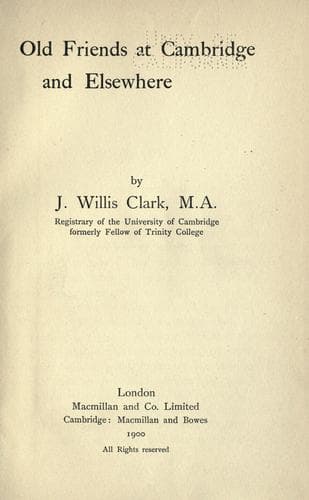
Old Friends at Cambridge and ElsewhereClark, John Willis
History
Old Friends at Cambridge and Elsewhere
Clark, John Willis
University of Cambridge -- History
Thirlwall lost no time in obeying the Master’s commands, and then issued
a circular to the Fellows of the college, enclosing a copy of the
Master’s letter, in order that they might learn what was ‘the power
claimed by the Master over the persons engaged in the public instruction
of the college, and the manner in which it has been exercised;’ and,
secondly, that he might learn from them how far they agreed with the
Master as to the propriety of his continuing a member of the Society. On
this point he entreated each of them to favour him with a ‘private,
explicit, and unreserved declaration’ of his opinions. It is needless to
say that one and all desired to retain him among them; and the Master’s
conduct was condemned by a large majority. It must not, however, be
supposed that Thirlwall’s own conduct was held to be free from fault. He
was much blamed for having resigned so hastily, without consulting any
one, as it would appear, except Whewell and Perry. Moreover, many of the
Fellows, among whom was Mr Hare, condemned the Master’s action, and
censured Thirlwall’s rashness in publishing such sentiments while
holding a responsible office, with almost equal severity. This feeling
explains, as we imagine, the very slight resistance made to an act
which, under any other circumstances, would have caused an explosion.
The Fellows felt that the victim had put himself in the wrong; and that,
much as they regretted the necessity of submission, it was the only
course to be taken. Thirlwall mentions in a letter to Professor Pryme
that when he showed the Masters communication to Whewell, the latter
‘expressed great regret,’ but ‘did not intimate that there could be any
doubt as to our connexion being at an end.’
It has often been said that Whewell did not exert himself as he might
have done to avert the catastrophe. We are glad to know, as we now do
most distinctly, from a letter written by him to Professor Sedgwick[54],
full of grief at what had happened, and of apprehension at its probable
consequences, that he had done all in his power to stay the Master’s
hand. He does not say, in so many words, that the Master had consulted
him _before_ he sent the letter; but he does say that ‘the Master’s
request to him (Mr Thirlwall) to resign the tuition I entirely
disapprove of, and expressed my opinion against it to the Master as
strongly as I could.’ If Thirlwall felt some resentment against Whewell
at first—as we believe he did—the feeling soon died away, and towards
the end of September he wrote him a long letter which ended with the
following passage:
Public-domain text, read in full here on John Shaqi.
Reviews
Reviews
No reviews yet
Be the first to share your thoughts on this work.
Join the Discussion
Join the discussion
Sign in to leave a comment or review.
Sign InorCreate an account