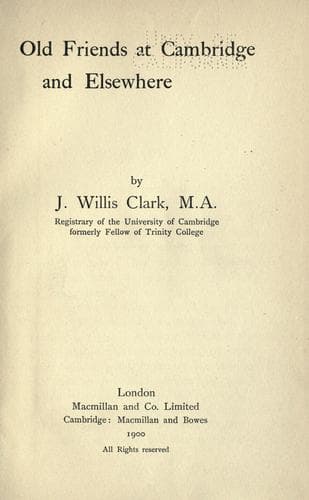
Old Friends at Cambridge and ElsewhereClark, John Willis
History
Old Friends at Cambridge and Elsewhere
Clark, John Willis
University of Cambridge -- History
‘Besides the explanations which I desired, your letter has afforded me a
still higher satisfaction, in shewing me that I am indebted to you for
an obligation on which I shall always reflect with pleasure and
gratitude—in the attempt which you made to avert the evil which my
imprudence had drawn upon me. And as this is the strongest proof you
could have given of the desire you felt to continue the relation in
which we stood with one another, so it encourages me to hope that I may
still find opportunities, before I leave this place, of co-operating
with you, though in a different form, for the like ends. But at all
events I shall never cease to retain that esteem and regard with which I
now remain yours most truly,
C. THIRLWALL[55].’
In reviewing the whole controversy at a distance of more than half a
century, with, we must admit, a strong bias in Thirlwall’s favour, it is
impossible not to admit that he had made a mistake. In all questions of
college management it is most important that the authorities should
appear, at any rate, to be unanimous; and the words ‘my imprudence,’
which occur in the passage quoted above from his letter to Whewell,
indicate that by that time he had begun to take the same view himself.
It is easy to see how he had been drawn into an opposite course. He had
never considered that he had anything to do with the chapel discipline;
he had agreed to attend himself, but he did not consider that such
attendance implied approval of the system. His own attendance, as we
learn from a contemporary, was something more than formal; he was rarely
absent, morning or evening; and his behaviour was remarkable for
reverence and devotion. With him, religion had nothing to do with
discipline; and it was infinitely shocking to his pure and thoughtful
mind to defile things heavenly with things earthly. The far too rigorous
rules of attendance which were then in force had exasperated the
undergraduates, and their behaviour, without being absolutely profane,
was careless and irreverent. Talking was very prevalent, especially on
surplice nights, when the service is choral. Thirlwall probably knew,
from the friendly intercourse which he maintained with the younger
members of the College, what their feelings were, and determined to do
his best to get a system altered which produced such disastrous results.
It must be remembered that at that time the Act of Uniformity prevented
any shortening of the service. Whewell’s mind was a very different one.
Without being a bigot, he had a profound respect for the existing order
of things; shut his eyes to any defects it might have, even when they
were pointed out to him; and regarded attempts to subvert it, or even to
weaken it, as acts of profanity.
Public-domain text, read in full here on John Shaqi.
Reviews
Reviews
No reviews yet
Be the first to share your thoughts on this work.
Join the Discussion
Join the discussion
Sign in to leave a comment or review.
Sign InorCreate an account