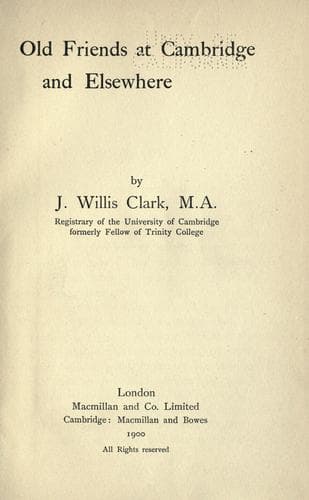
Old Friends at Cambridge and ElsewhereClark, John Willis
History
Old Friends at Cambridge and Elsewhere
Clark, John Willis
University of Cambridge -- History
It will be readily conceived that these events rendered Cambridge no
pleasant place of residence for Thirlwall, deprived of his occupation as
a teacher and unsupported by any particularly strong force of liberal
opinion in the University. Yet he had the courage to make the experiment
of continuing to live in college. He went abroad for the Long Vacation
of 1834, and returned at the beginning of the October term. In a few
weeks, however, the course of his life was changed by an unexpected
event. Lord Melbourne’s first Ministry broke up, and just as Lord
Chancellor Brougham was regretting that Sedgwick and Thirlwall were the
only clergymen who had deserved well of the Liberal party for whom he
had been unable to provide, came the news of the death of a gentleman
who was both canon of Norwich and rector of Kirby Underdale, a valuable
but very secluded living in Yorkshire. He at once offered the canonry to
Sedgwick and the rectory to Thirlwall. Both offers were accepted, we
believe, without hesitation; and both appointments, though evidently
made without regard to the special fitness of the persons selected, were
thoroughly successful. Sedgwick threw himself into the duties of a
cathedral dignitary with characteristic vigour; and Thirlwall, whose
only experience of parochial work had been at Over, in Cambridgeshire, a
small village without a parsonage, of which he was vicar for a few
months in 1829, became a zealous and popular parish priest. We are told
that ‘the recollection still survives of regular services with full and
attentive congregations, including incomers from neighbouring villages;
of the frequent visits to the village school; of the extempore prayers
with his flock, of which the larger number were Dissenters; of the
assiduous attentions to the sick and poor.’ And his old friend Hare,
writing to Whewell in 1840, describes his work in his parish as
‘perfect,’ and holds up his example as ‘an encouragement’ to his
correspondent to go and do likewise[56].
Public-domain text, read in full here on John Shaqi.
Reviews
Reviews
No reviews yet
Be the first to share your thoughts on this work.
Join the Discussion
Join the discussion
Sign in to leave a comment or review.
Sign InorCreate an account