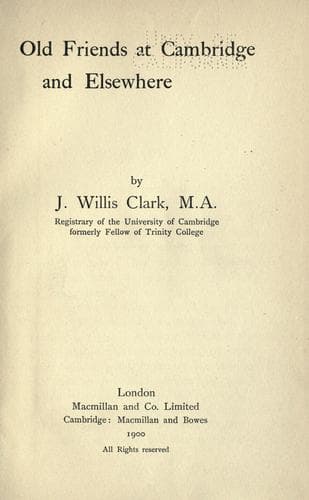
Old Friends at Cambridge and ElsewhereClark, John Willis
History
Old Friends at Cambridge and Elsewhere
Clark, John Willis
University of Cambridge -- History
It must not, however, be supposed that Bishop Thirlwall lived the life
of an indolent man of letters. No bishop ever performed the duties of
his position more thoroughly, or with greater sacrifice of personal ease
and comfort. His first care was to learn Welsh, and in a little more
than a year he could read prayers and preach in that language. In his
large and little-known diocese locomotion was not easy, and
accommodation was often hard to obtain. Yet he visited every part of it,
personally inspected the condition of the schools and churches
(deplorable enough in 1840), and regularly performed the duties of
confirmation, preaching, and visitation. In the charge of 1866 he
reviewed the improvements which had been accomplished up to that time,
and could mention 183 churches to the restoration of which the Church
Building Society had made grants, and more than thirty parishes in which
either new or restored churches were in progress. Besides these, there
were some which had been restored by private munificence; others,
including the cathedral, by public subscription; many parsonages had
been built, livings had been augmented, and education had been largely
increased[67]. To all these excellent objects he had himself been a
munificent contributor, and we believe that between the beginning and
the end of his episcopate he had spent nearly £40,000 in charities of
various kinds[68]. Yet with all these claims on the gratitude of the
clergy we are sorry to have to admit that he was not personally popular.
It would have been more wonderful perhaps had he been so. The Welsh
clergy forty years ago were a rough and uncultivated body of men,
narrow-minded and prejudiced, and with habits hardly more civilized than
those of the labourers around them. They were ill at ease with an
English man of letters. He was to them an object of curiosity, possibly
of dread. The new Bishop intimated his wish that the clergy should come
to his house without restraint, and when there should be treated as
gentlemen and equals. This was of itself an innovation. In his
predecessor’s time when a clergyman called at Abergwili he entered by
the back door, and if he stayed to dinner he took that meal in the
housekeeper’s room with the upper servants. Thirlwall abolished these
customs, and entertained the clergy at his own table. This was excellent
in intention, but impossible in practice. The difference in tastes,
feelings, manners, between the entertainer and the entertained made
social intercourse equally disagreeable to both parties; and the Bishop
felt obliged to substitute correspondence for visits, so far as he
could, reserving personal intercourse for the archdeacons, or those
clergymen whose education enabled them to appreciate his friendship[69].
Again, the peculiar tone of his mind must be remembered. He was nothing
if not critical; and, further, as one of his oldest friends once said in
our hearing, ‘he was the most thoroughly veracious man I ever knew.’ He
Public-domain text, read in full here on John Shaqi.
Reviews
Reviews
No reviews yet
Be the first to share your thoughts on this work.
Elsewhere in the archive
Join the Discussion
Join the discussion
Sign in to leave a comment or review.
Sign InorCreate an account