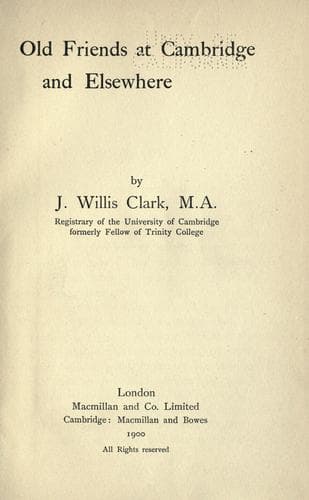
Old Friends at Cambridge and ElsewhereClark, John Willis
History
Old Friends at Cambridge and Elsewhere
Clark, John Willis
University of Cambridge -- History
could not listen to a hasty, ill-considered, remark without taking it to
pieces, and demonstrating, by successive questions, put in a slow,
deliberate tone of voice, the fallacy of the separate parts of the
proposition, and, by consequence, of the whole. Hence he was feared and
respected rather than beloved; and those who ought to have been proud of
having such a man among them wreaked their small spite against him by
accusing him of being inhospitable, of walking out attended by a dog
trained to know and bite a curate, and the like. These slanders, of
which we hope he was unconscious, he could not answer; those who
attacked him in public he could and did crush with an accuracy of
exposition, and a power of sarcasm, for which it would be hard to find a
parallel. We need only refer to his answers to Sir Benjamin Hall, M.P.
for Marylebone, on the general question of the condition of the churches
in his diocese, appended to his charge for 1851, and on the special case
of the Collegiate Church of Brecon, in two letters to the Archbishop of
Canterbury; or to the _Letter to the Rev. Rowland Williams_, published
in 1860. Mr Williams had published some sermons, entitled _Rational
Godliness_, the supposed heterodoxy of which had alarmed the clergy of
his diocese, seventy of whom had signed a memorial to the Bishop,
praying him to take some notice of the book; in other words, to remove
the author from the college at Lampeter, of which he was vice-principal.
The Bishop had declined to interfere, and in his charge of 1857 had
discussed the question at length, considering it, as was his manner,
from all points of view, and, while he found much to blame, defending
the author’s intentions, on the ground of the high opinion of his
personal character which he himself held. This, however, did not satisfy
Mr Williams. We cannot help suspecting that he was longing for a
martyr’s crown; and, indignant at not having obtained one, he addressed
the Bishop at great length in what he called _An Earnestly Respectful
Letter on the Difficulty of bringing Theological Questions to an Issue_.
He described the charge as ‘a miracle of cleverness,’ but deplored its
indefiniteness; he drew a picture of ‘a preacher in our wild mountains’
who came to seek counsel from his bishop and got only evasive
answers—‘in all helps for our guidance Abergwili may equal Delphi in
wisdom, but also in ambiguity[70]’—and entreated the Bishop to declare
plainly his own opinion on the questions raised. For once Bishop
Thirlwall’s serenity was fairly ruffled. Stung by the ingratitude of a
man whom he had steadily befriended, and whose aim was, as he thought,
to draw him into admissions damaging to himself, he struck with all his
might and main, and, as was said at the time, ‘you may hear every bone
in his adversary’s body cracking.’ One specimen of the remarkable power
of his reply must suffice. On the comparison of himself to the Delphic
oracle he remarked:
Public-domain text, read in full here on John Shaqi.
Reviews
Reviews
No reviews yet
Be the first to share your thoughts on this work.
Elsewhere in the archive
Join the Discussion
Join the discussion
Sign in to leave a comment or review.
Sign InorCreate an account