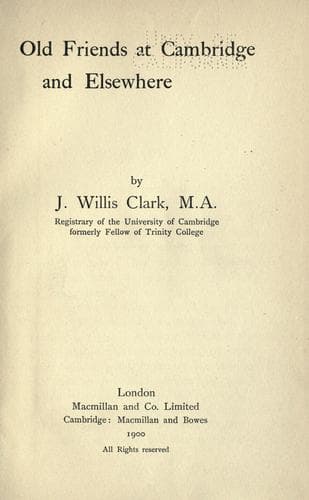
Old Friends at Cambridge and ElsewhereClark, John Willis
History
Old Friends at Cambridge and Elsewhere
Clark, John Willis
University of Cambridge -- History
Thirlwall’s position towards theological questions has been called
‘indefinable[74].’ In a certain sense this statement is no doubt true.
It was quite impossible to label him as of this or that party or
faction; or to predict with any approach to certainty what he would do
or say on any particular occasion. He had no enthusiasm (in the ordinary
sense of the word) and no sentiment, and therefore, when a question was
submitted to him, he did not decide it in the light of previous
prejudices, or welcome it as a point gained towards some cherished end.
He considered it as if it were the only question in the world at that
moment, and as if he had never heard of it, or anything like it, before;
he looked all round it, and balanced the arguments for and against it
with the accuracy of a man of science in a laboratory. As a result of
this process he frequently came to no resolution at all, and frankly
told his correspondent that he would leave the matter referred to him to
the decision of others. But, if what he held to be truth was assailed,
or the conduct of an individual unjustly called in question, Thirlwall’s
hesitation vanished. We have already mentioned his conduct in the House
of Lords; but it should never be forgotten that he was one of the four
Bishops who dissented from the resolution to inhibit Bishop Colenso from
preaching in the various dioceses of England; and that he stood alone in
withholding his signature from the address requesting him to resign his
see. Again, when Mr J. S. Mill was a candidate for Westminster in 1865,
and his opponents circulated on a placard some lines from his
_Examination of Sir W. Hamilton’s Philosophy_ intended to shock the
minds of the electors as irreverent if not blasphemous,—a proceeding
which was eagerly followed up by the _Record_ and the _Morning
Advertiser_ in leading articles—Thirlwall at once wrote to the
_Spectator_, maintaining that this passage contained “the utterance of a
conviction in harmony with ‘the purest spirit of Christian morality’;
that nothing but ‘an intellectual and moral incapacity worthy of the
‘Record’ and its satellite could have failed to recognise its truth’;
and that it ‘thrilled’ him ‘with a sense of the ethical sublime’[75].”
Public-domain text, read in full here on John Shaqi.
Reviews
Reviews
No reviews yet
Be the first to share your thoughts on this work.
Elsewhere in the archive
Join the Discussion
Join the discussion
Sign in to leave a comment or review.
Sign InorCreate an account