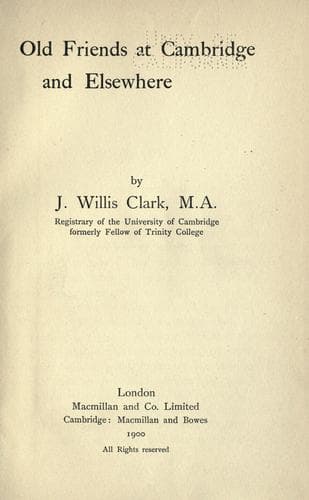
Old Friends at Cambridge and ElsewhereClark, John Willis
History
Old Friends at Cambridge and Elsewhere
Clark, John Willis
University of Cambridge -- History
Had the Bishop added that he wished each of these parties to have fair
play, but that none should be exalted at the expense of the others, we
should have had a summary of the principles which regulated his public
life. Let it not, however, be supposed that he was an indifferent
looker-on. He held that truth had many sides; that it might be viewed in
different ways by persons standing in different positions; but still it
was to him clear, and definite, and based upon a rock which no human
assailant could shake. This, we think, is the keynote which is struck in
every one of those eleven most remarkable Charges which are now for the
first time collected together. We would earnestly commend them to the
study of all who are interested in the history of the Church of England
during the period which they cover. Every controversy which agitated
her, every measure which affected her welfare, is discussed by a master;
the real question at issue is carefully pointed out; the trivial is
distinguished from the important; moderation and charity are insisted
upon; angry passions are allayed; and, while the liberty of the
individual is perpetually asserted, the duty of maintaining her
doctrines is strenuously inculcated. As illustrations of some of these
characteristics we would contrast his exhaustive analysis of the
Tractarian movement or the Gorham controversy, with his conduct
respecting _Essays and Reviews_. In the former cases he hesitated to
condemn; he preferred to allay the terror with which his clergy were
evidently inspired. In the latter, though always ‘decidedly opposed to
any attempt to narrow the freedom which the law allows to every
clergyman of the Church of England in the expression of his opinion on
theological subjects,’ he joined his brother bishops in signing the
famous ‘Encyclical,’ which we now know was the composition of Bishop
Wilberforce, because he thought that in this case the principles
advocated led to a negation of Christianity.
Public-domain text, read in full here on John Shaqi.
Reviews
Reviews
No reviews yet
Be the first to share your thoughts on this work.
Elsewhere in the archive
Join the Discussion
Join the discussion
Sign in to leave a comment or review.
Sign InorCreate an account