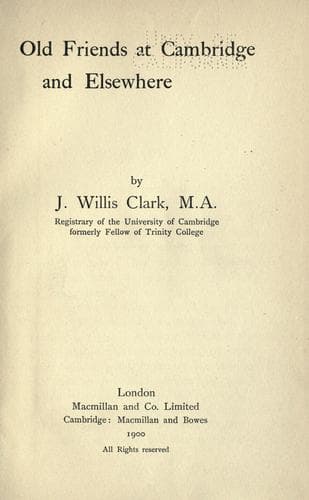
Old Friends at Cambridge and ElsewhereClark, John Willis
History
Old Friends at Cambridge and Elsewhere
Clark, John Willis
University of Cambridge -- History
4. _Letters, Literary and Theological, of Connop Thirlwall, late Lord
Bishop of S. David’s._ Edited by the Very Rev. J. J. STEWART PEROWNE,
D.D., Dean of Peterborough, and the Rev. LOUIS STOKES, B.A. Corpus
Christi College, Cambridge. With Annotations and Preliminary Memoirs
by the Rev. LOUIS STOKES. 8vo. (London, 1881.)
5. _Letters to a Friend._ New Edition. (London, 1882.)
Footnote 19:
Dr Perowne’s Preface to _Letters_, &c., p. vi.
Footnote 20:
_Letters_, &c., p. 177.
Footnote 21:
_Primitiæ_, p. 52. The essay is endorsed: ‘Composed 1st January, 1806.
Eight years old.’
Footnote 22:
_Primitiæ_, p. 224. The piece is dated October 28, 1808.
Footnote 23:
_Letters to a Friend_, p. 155. As a matter of fact the Bishop did buy
and destroy all the copies that he could.
Footnote 24:
Dean Perowne mentions (Preface, p. viii.) that ‘at school he did not
care to enter into the games and amusements of the other boys, but was
to be seen at play-hour withdrawing himself into some corner with a
pile of books under his arm.’
Footnote 25:
Candler was seven years older than Thirlwall. He was junior assistant
in a draper’s shop at Ipswich, and afterwards set up in business on
his own account at Chelmsford, where he became a leading member of the
Society of Friends. He died, nearly eighty years of age, in 1872. We
have not been able to ascertain how he became acquainted with
Thirlwall.
Footnote 26:
_Letters_, &c., p. 7.
Footnote 27:
_Letters_, &c., p. 17.
Footnote 28:
_Ibid._ p. 8.
Footnote 29:
_Letters to a Friend_, p. 225.
Footnote 30:
_Letters_, &c., p. 21. The letter is dated December, 1813, when the
writer was sixteen years old.
Footnote 31:
Professor Monk, who had examined Thirlwall on one of these occasions,
was so much struck with the vigour and accuracy of his translations
that he remarked to a friend, who had also had experience of his worth
as a scholar, ‘Had I been sitting in my library, with unlimited access
to books, I could not have done better.’ ‘Nor so well,’ was the reply.
Footnote 32:
Cooper’s _Annals of the Town and University of Cambridge_, iv. 516.
The words between inverted commas in our text are from a pamphlet
entitled ‘A Statement regarding the Union, an Academical Debating
Society, which existed at Cambridge from February 13, 1815, to March
24, 1817, when it was _suppressed by the Vice-Chancellor_.’ The
‘statement’ is evidently official, and is thoroughly business-like and
temperate. The Vice-Chancellor was Dr Wood, Master of S. John’s
College; the officers of the society were: Mr Whewell, _President_; Mr
Thirlwall, _Secretary_; Mr H. J. Rose, _Treasurer_. The late Professor
Selwyn, in a speech at the opening of the new Union building, October
30, 1866, stated that on the entrance of the proctors the President
said, ‘Strangers will please to withdraw, and the House will take the
message into consideration.’
Public-domain text, read in full here on John Shaqi.
Reviews
Reviews
No reviews yet
Be the first to share your thoughts on this work.
Elsewhere in the archive
Join the Discussion
Join the discussion
Sign in to leave a comment or review.
Sign InorCreate an account