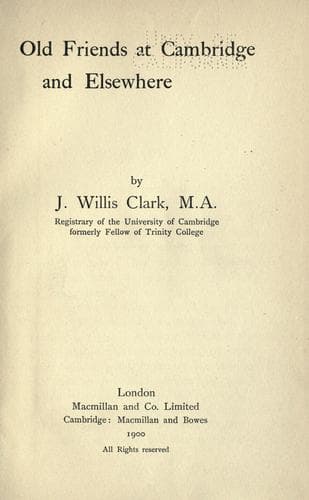
Old Friends at Cambridge and ElsewhereClark, John Willis
History
Old Friends at Cambridge and Elsewhere
Clark, John Willis
University of Cambridge -- History
On the Life of Dr Whewell, printed above. It was originally called
‘Half a Century of Cambridge Life,’ and appeared in the _Church
Quarterly Review_, April 1882.
Footnote 48:
The _Caput Senatus_ consisted of five persons, viz. a Doctor of
Divinity, a Doctor of Laws, a Doctor of Physic, a non-regent Master,
and a regent Master. These persons held office for a year. They were
elected by the votes of the Heads of Colleges, the Doctors in all
faculties, and the Scrutators. Each member had the right to veto any
proposal of which he disapproved. The _Caput Senatus_ was established
by the Statutes of Elizabeth, 1570, Cap. xli, and abolished by the
University Act, 1856.
Footnote 49:
The first petition was presented to the House of Lords on March 21,
1834; the protest is dated April 3; and the counter-petition was
presented on April 21 in the same year.
Footnote 50:
_A Letter_ etc., p. 20.
Footnote 51:
_A Letter_ etc., pp. 21, 22.
Footnote 52:
When the ‘Society for the Prevention of Cruelty to Undergraduates’
tabulated the weekly attendance of the Fellows at Chapel in the Lent
Term of 1838, and finally published a list, like the class list at the
end of an examination, Whewell was placed in the middle of the second
class, having obtained only 34 marks. The Deans, being obliged, in
virtue of their office, to attend twice daily, were disqualified from
obtaining the prize—a Bible—which the Society gave to Mr Perry,
afterwards Bishop of Melbourne, who had obtained 66 marks.
Footnote 53:
It has been said that the Master was advised to take the course he did
by Mr Hugh James Rose, who was in the University at the time, and on
Whitsunday, May 18, had preached a sermon at Great S. Mary’s on the
‘Duty of Maintaining the Truth,’ from S. Matt. x. 27: ‘What ye hear in
the ear, that preach ye upon the house-tops.’ Thirlwall’s letter,
however, was not published before May 21, so that, unless the nature
of it had been known beforehand, it is clear that anything which Mr
Rose had said in his sermon could not have referred to it. That
Thirlwall believed that there was some connexion between the sermon,
or at any rate the preacher, and his dismissal, is evident from the
fact that after showing the Master’s letter to one of the junior
Fellows, who expressed indignant surprise that such a course could
have been taken, he remarked: ‘Ah! let this be a warning to you to
preach truth, if need be, upon the house-tops, but never under any
circumstances to preach error.’ Thirlwall was a regular attendant at
Great S. Mary’s, and no doubt heard the sermon in question.
Footnote 54:
The letter, dated 27 May, 1834, is printed by Mrs Stair Douglas, _Life
of Dr Whewell_, p. 163.
Footnote 55:
Public-domain text, read in full here on John Shaqi.
Reviews
Reviews
No reviews yet
Be the first to share your thoughts on this work.
Elsewhere in the archive
Join the Discussion
Join the discussion
Sign in to leave a comment or review.
Sign InorCreate an account