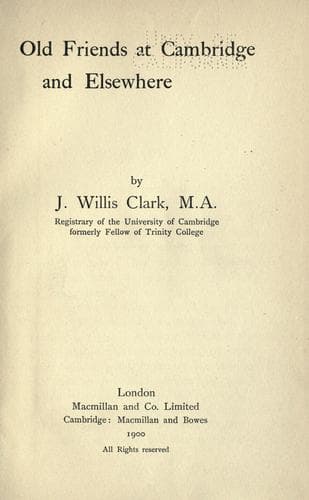
Old Friends at Cambridge and ElsewhereClark, John Willis
History
Old Friends at Cambridge and Elsewhere
Clark, John Willis
University of Cambridge -- History
He particularly disliked gossip. At Kirby Underdale the old sexton
used to relate how Mr Thirlwall said, ‘I never ’ears no tales’; and
the following story shows that he maintained the same wise discretion
after he became a bishop. One of his archdeacons thought it right to
tell him that a certain clergyman in the diocese, who was a clever
mimic, was fond of entertaining his friends with imitations of the
Bishop. Thirlwall listened, and then inquired, ‘Does he do me well?’
‘I am sure I cannot say, my Lord,’ replied the informer; ‘I was never
present myself at one of these disgraceful exhibitions.’ ‘Ah! I should
like to know, because he does _you_ admirably,’ replied the Bishop. It
is needless to say that no more stories were carried to his ears.
Footnote 70:
_An Earnestly Respectful Letter_, 8vo. 1860, pp. 20-23. See also _The
Life and Letters of Rowland Williams, D.D._, London, 1874, chap. xv.,
where his determination to make the Bishop declare himself, under the
belief that he really agreed with him, is expressly stated.
Footnote 71:
_A Letter to the Rev. Rowland Williams_, 8vo. 1860, p. 19.
Footnote 72:
Dean Stanley’s preface to the _Letters to a Friend_, p. xi.
Footnote 73:
_Letters to a Friend_, p. 54.
Footnote 74:
Review of ‘The letters of Bishop Thirlwall,’ _The Times_, 23 November,
1881.
Footnote 75:
_The Edinburgh Review_, for April, 1876, p. 292.
Footnote 76:
These words are inscribed upon Bishop Thirlwall’s grave.
RICHARD MONCKTON MILNES,
LORD HOUGHTON[77].
Public-domain text, read in full here on John Shaqi.
Reviews
Reviews
No reviews yet
Be the first to share your thoughts on this work.
Elsewhere in the archive
Join the Discussion
Join the discussion
Sign in to leave a comment or review.
Sign InorCreate an account