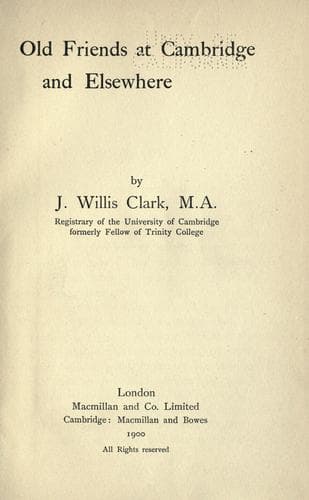
Old Friends at Cambridge and ElsewhereClark, John Willis
History
Old Friends at Cambridge and Elsewhere
Clark, John Willis
University of Cambridge -- History
Richard Monckton Milnes was born in London, June 19, 1809. His father,
Robert Pemberton Milnes, then a young man of twenty-five, and M.P. for
the family borough of Pontefract, had just flashed into sudden celebrity
in the House of Commons by a brilliant speech in favour of Mr Canning,
which saved the Portland Administration, and would have made Mr Milnes’s
political fortune, had he been so minded. But when Mr Perceval offered
him a seat in the Cabinet, either as Chancellor of the Exchequer or as
Secretary of War, he exclaimed, ‘Oh, no: I will not accept either; with
my temperament, I should be dead in a year.’ That he had entered
Parliament with high hopes, and confidence in his own powers to win
distinction there, is plain from the well-known story (which his son
evidently believed) that he laid a bet of 100_l._ that he would be
Chancellor of the Exchequer in five years. But, when the time came, he
declined to ‘take occasion by the hand,’ and sat down under the oaks of
Fryston to spend the rest of his life, just half a century, in the
placid uniformity of a country gentleman’s existence. His abandonment of
public life, and his refusal to return to it in any form, even when,
late in life, Lord Palmerston offered him a peerage, were unsolved
riddles to his contemporaries. Those who read these volumes will have
but little difficulty in finding the answer to it. He was endowed with a
proud independence of judgment which could never bind itself to any
political party, and a critical fastidiousness which made him hesitate
over every question presented to him. These two qualities of mind were
conspicuous in his son, and barred to some extent his advancement, as
they had barred his father’s. It must not, however, be imagined that the
elder Milnes was an indolent man. Far from it. He was a daring rider to
hounds, a scientific agriculturist, an active magistrate, a stimulator
of the waning Toryism of Yorkshire by speeches which showed what the
House of Commons had lost when he left it, and ardently curious about
men of note and events of interest—another characteristic which
descended to his son. Occasionally, too, he yielded to a love of
excitement which Yorkshire could not gratify, and revisited London, to
tempt the fickle goddess who presides over high play—a taste which cost
him dear, for it compelled him to pass several years of his life in
comparative obscurity abroad, while the rents in his fortune, due to his
own and his brother’s extravagance, were being slowly repaired. We have
been told, by one who knew him late in life, that he was a singularly
loveable person—the delight of children and young people—full of jokes,
and fun, and _persiflage_. ‘You could never be sure whether he spoke in
jest or in earnest,’ said our informant. Here again one of the most
obvious characteristics of his son makes its appearance.
Public-domain text, read in full here on John Shaqi.
Reviews
Reviews
No reviews yet
Be the first to share your thoughts on this work.
Elsewhere in the archive
Join the Discussion
Join the discussion
Sign in to leave a comment or review.
Sign InorCreate an account