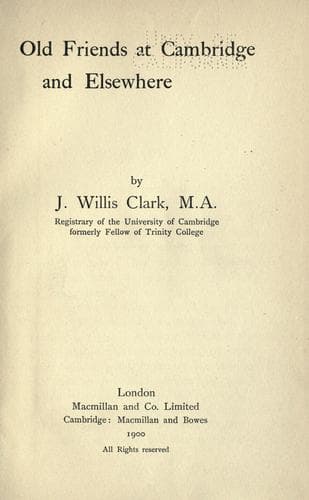
Old Friends at Cambridge and ElsewhereClark, John Willis
History
Old Friends at Cambridge and Elsewhere
Clark, John Willis
University of Cambridge -- History
‘I do not believe that I was guilty of the rashness of throwing the
javelin over the Cam. It was, I think, a passage of arms got up by the
Eton men of the two Unions. My share, if any, was only as a member of
the august committee of the green baize table. I can, however, remember
the irruption of the three Cambridge orators. We Oxford men were
precise, orderly, and morbidly afraid of excess in word or manner. The
Cambridge oratory came in like a flood into a mill-pond. Both Monckton
Milnes and Henry [Arthur] Hallam took us aback by the boldness and
freedom of their manner. But I remember the effect of Sunderland’s
declaration and action to this day. It had never been seen or heard
before among us; we cowered like birds, and ran like sheep.... I
acknowledge that we were utterly routed. Lord Houghton’s beautiful
reviving of those old days has in it something fragrant and sweet, and
brings back old faces and old friendships, very dear as life is drawing
to its close.’
Mr Milnes had always wished that his son should become distinguished in
that House of Commons where he had himself made so brilliant a _début_.
With this object in view, he had urged him to cultivate speaking in
public, and probably the only part of his Cambridge career which he
viewed with complete satisfaction was his interest in, and success at,
the Union Debating Society. But even in this they did not quite agree.
Mr Milnes urged his son to take a decided line, and to lead the Union.
But the only answer he could get was, ‘If there is one thing on which I
have ever prided myself, it is on having no politics at all, and judging
every measure by its individual merits. A leader there must be a violent
politician and a party politician, or he must have a private party. I
shall never be the one or have the other.’ Again, they were at variance
on the burning question of the day, the Reform Bill. Mr Milnes, though a
Conservative, was in favour of it; his son described it as ‘the curse
and degradation of the nation.’ Further, while exhorting his son to
prepare himself for public life, with a singleness of purpose that, if
adhered to, would have excluded other and more congenial pursuits, Mr
Milnes warned him that his circumstances would not allow him to enter
parliament. No wonder, therefore, that the young man became perplexed
and melancholy, and more than ever anxious to find a refuge for his
aspirations in literature.
Public-domain text, read in full here on John Shaqi.
Reviews
Reviews
No reviews yet
Be the first to share your thoughts on this work.
Elsewhere in the archive
Join the Discussion
Join the discussion
Sign in to leave a comment or review.
Sign InorCreate an account