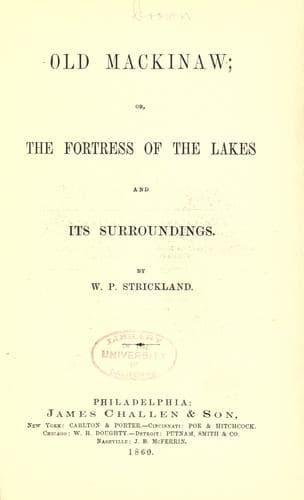
Old Mackinaw; Or, The Fortress of the Lakes and its SurroundingsStrickland, W. P. (William Peter)
History
Old Mackinaw; Or, The Fortress of the Lakes and its Surroundings
Strickland, W. P. (William Peter)
Great Lakes (North America); Mackinac Island (Mich. : Island) -- History; Michigan -- History
The annual _increment_ from 1840 to 1850, was 50,000 per annum, or
about six per cent. The annual increment from 1850 to 1857, was
172,000, or about twelve per cent. The _ratio_ of increase is,
therefore, increasing, and we may assume it will not be less than
_ten_ per cent, per annum till 1860. This will give 3,380,000 for
1860, or _fourfold the population_ of 1840! At a diminishing ratio the
territory round Mackinaw will contain 5,400,000 in 1870, and
(8,000,000) _eight millions_ in 1880. The principal city of the
district (wherever it may be) must then contain about _one hundred
thousand inhabitants_.
Of the cities and towns we have above enumerated, the greatest and
most rapid in its development is Chicago, whose first warehouse lot
was sold in 1834, and which, in 1857, is said to contain near one
hundred thousand inhabitants. Let us, for a moment, compare the
_material advantages and resources_ of that place, with those of
Mackinaw city. Dean Swift said, that a large city must combine the
resources of agriculture, commerce and manufactures. Cities have
risen, however, to large size almost exclusively on commerce. Witness
Tyre and Palmyra. But commerce, we concede, when left to itself, is so
fluctuating, that the cities it builds, like Tyre and Palmyra, may, in
the decay of commerce, be left to ruin and desolation. Cities may,
likewise, be built up almost exclusively on manufactures, such as
Birmingham and Sheffield; and it is quite remarkable that the oldest
and most stable cities have depended largely on manufactures.
Damascus, the oldest historical city--which has resisted all the
destructive influences of time and revolution--has always been a
manufacturing town. Paris, Lyons, Lisle, the great interior towns of
France, depend very largely on the manufacture of fine and fashionable
articles, distributed throughout Europe and America. Of the great
elements of civic success, we consider manufactures the most
important; but, to make a city of the first magnitude, it is obviously
necessary to have all the resources of food, industry and commerce.
Chicago is remarkable chiefly as a grain city--like Odessa, on the
Baltic. But, whence is the grain derived? By the construction of
railroads, at that point, from Indiana, Illinois, Missouri, Wisconsin
and Iowa, the whole mass of surplus grain in that region--amounting
to more than twenty millions of bushels per annum--has been exported
from Chicago. But, this is the drainage of three hundred thousand
square miles, two-thirds of which will not export through Chicago when
railroads extend directly east to Milwaukee, Superior and Mackinaw,
from Wisconsin and Iowa, and connect, from the south, at Cairo, with
Missouri and Illinois. Reduced to its own proper limits, the
agricultural resources of Chicago must be confined to half the surface
of Illinois, Missouri and Iowa, or about one hundred thousand square
miles. This is but little over one-third the surface drained of
Public-domain text, read in full here on John Shaqi.
Reviews
Reviews
No reviews yet
Be the first to share your thoughts on this work.
Elsewhere in the archive
Join the Discussion
Join the discussion
Sign in to leave a comment or review.
Sign InorCreate an account