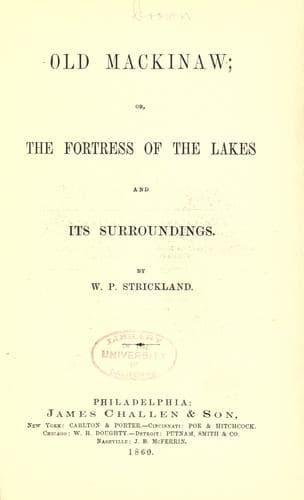
Old Mackinaw; Or, The Fortress of the Lakes and its SurroundingsStrickland, W. P. (William Peter)
History
Old Mackinaw; Or, The Fortress of the Lakes and its Surroundings
Strickland, W. P. (William Peter)
Great Lakes (North America); Mackinac Island (Mich. : Island) -- History; Michigan -- History
"The tract of country under consideration is based on limestone,
sandstone, and shales, which are covered, excepting at a few points,
with a deposit of red clay and sand, varying in thickness from a few
inches to more than four hundred feet. The interior of the northern
portion of the peninsula, west of the meridian, is generally more
rolling than that on the east. It is interspersed with some extensive
cedar swamps and marshes, on the _alluvial_ lands, and in the vicinity
of heads of streams and some of the lakes. The upland is generally
rolling, has a soil of clay, loam and sand, and is clad with evergreen
timber, intermixed with tracts of beech and maple, varying in extent
from a few acres to several townships. Several of the most extensive
of these tracts are in the vicinity of the Cheboygan and Tahweegon
rivers, their lakes and tributary streams. There are also large tracts
of beech and maple timber lying between the head of Grand Traverse
Bay, and the Manistee and Muskeegon rivers.
"The elevated portion of land on the shore of Lake Michigan, known as
the 'Sleeping Bear' as well as Manitou Island, (see latitude 45)
which, when viewed from a distance, has the appearance of sand, is
found to be composed of alternate layers of highly marly clay and
sand. The clay is of a deep red color, and in many places its strata
are much contorted.
"The hilly region, to which allusions have been made, is mostly
heavily timbered with beech, maple, bass, oak, ash, elm, birch, etc.,
interspersed with an occasional cedar swamp. In the vicinity of Grand
Traverse Bay, this character of country extends into the interior for
many miles, bordering on a series of small and beautiful lakes, which
vary in length from two to eighteen miles, and are generally free from
marsh and swamp. This country, as also that in the interior from
Little Traverse Bay, is well adapted to the purposes of agriculture.
"Passing south of this rolling district, the country becomes less
elevated and more variable, the soil assuming a more sandy character,
and being generally clad with evergreen timber. There are, however,
exceptions to this in some fine tracts of beech and maple near the
lake coast, also, in the vicinity of some of the streams in the
interior.
"It is nevertheless true, that there are many extensive swamps and
marshes in this part of the peninsula, but it is doubted whether, upon
the whole, they exceed the quantity or extent of those of the more
southern part of the State.
"In point of soil and timber, this portion of the State is not
inferior to the more southern--and such are the advantages it offers
to the settler, that the day is not distant when it will be sought as
a place of residence by the agriculturist.
"The beauty of its lakes and streams is not anywhere surpassed. Such
is the transparency of their waters as to permit objects to be
distinctly seen at the depth of more that thirty feet.
Public-domain text, read in full here on John Shaqi.
Reviews
Reviews
No reviews yet
Be the first to share your thoughts on this work.
Elsewhere in the archive
Join the Discussion
Join the discussion
Sign in to leave a comment or review.
Sign InorCreate an account