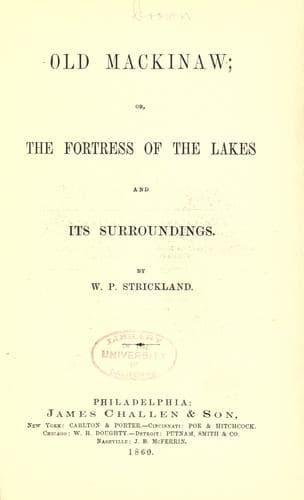
Old Mackinaw; Or, The Fortress of the Lakes and its SurroundingsStrickland, W. P. (William Peter)
History
Old Mackinaw; Or, The Fortress of the Lakes and its Surroundings
Strickland, W. P. (William Peter)
Great Lakes (North America); Mackinac Island (Mich. : Island) -- History; Michigan -- History
The fact is not generally known, but the information has been
purchased at a dear rate, that the purchase of lumber for the foreign
market by board-measure, instead of cubic, involves a heavy loss. In
European markets all lumber is sold by the cubic foot, so that the
cost of sawing is completely thrown away. Black walnut, for example,
cannot be laid down in Detroit, or any lake port, under $18 to $20 per
M., while the lumber can be obtained for $125 to $150 per M. cubic
feet, 1,000 feet cubic measure being equal to 12,000 feet board
measure. Thus in purchasing by cubic measure, the buyer pays only $125
to $150 for an amount that by board measure would cost $216 to $240,
making a clear difference of _ninety dollars_ upon only one thousand
cubic feet, equal to $900 upon a cargo of some of the vessels engaged
in the trade last year. The same rule would apply substantially to
other kinds of lumber. Independent of this, a decided preference is
given to lumber in the log, owing to the good condition in which it
can be delivered. There is one more point which manufacturers as well
as shippers should bear in mind. The value of much of the lumber sent
out was greatly impaired by being attached to the heart, which is the
most porous part of the tree, and therefore most liable to crack. To
obviate this objection the saw should pass upon each side of the
heart, thus leaving the whole of it attached to a single piece of
timber, instead of one or more pieces, and thereby making only one
cull. By observing this rule a difference will be made in the market
of thirty or forty per cent.
Are staves or lumber the more profitable to ship? This depends upon
circumstances. Last year it was very dull for both. For staves
especially the season could not, for various reasons, have been more
unfavorable. In the first place, the grape crop was a very short one,
not only in France, but in all the vine countries, including the
Canaries. This, of course, greatly lessened the demand for staves, and
there were consequently very few taken from England to France,
although French vessels are in the habit of taking them for ballast at
a merely nominal rate, owing to the difficulty they experience in
procuring return freights from England. The short crops in Canada and
the great scarcity of money, forced an unusual number of laborers in
that country into the stave and lumber business. Under advices that
heavy shipments were in prospect, coupled with the general check upon
business on account of the war, prices became depressed.
Notwithstanding all this, the shipments hence, being early in the
market, sold to advantage, and may therefore be considered as a signal
success, under the circumstances. The smallest vessel going out from
here netted a freight of $3,500.
Public-domain text, read in full here on John Shaqi.
Reviews
Reviews
No reviews yet
Be the first to share your thoughts on this work.
Elsewhere in the archive
Join the Discussion
Join the discussion
Sign in to leave a comment or review.
Sign InorCreate an account