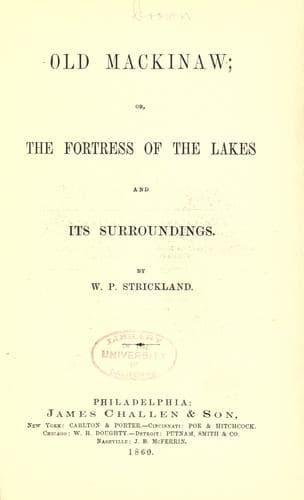
Old Mackinaw; Or, The Fortress of the Lakes and its SurroundingsStrickland, W. P. (William Peter)
History
Old Mackinaw; Or, The Fortress of the Lakes and its Surroundings
Strickland, W. P. (William Peter)
Great Lakes (North America); Mackinac Island (Mich. : Island) -- History; Michigan -- History
In former years the prices of grain in the United States were
controlled by the European markets, and consequently the grain trade
of the Western States was governed by the produce merchants in the
Atlantic ports, but lately the whole order of things seems to have
been reversed, as breadstuffs of every kind were dearer in the Western
than in the Eastern markets. There were several reasons for this
anomaly. On account of the ravages of insects, and other causes which
we have alluded to, farmers were induced to place very little reliance
on the wheat crop, and many were driven into other branches of
husbandry, and in some places wheat became scarce. Add to this the
rapid increase of the population which created a local demand for all
kinds of food, and caused immense quantities of breadstuffs to be
required in places where a few years before there was no market for
anything. The rapid and extraordinary growth of Detroit and all the
Western cities, and the formation of new settlements, created a home
market for Western produce, for the population of cities being
consumers of the fruits of the land, instead of producers, have
always a wonderful effect on the markets of their localities, and the
pioneers in the forest or prairie must for a time depend on the older
settlements for subsistence.
From a defective system of agriculture the soil of the old States has
been deteriorating for several years. In Massachusetts the hay crop
declined twelve per cent. from 1840 to 1850, notwithstanding the
addition of 90,000 acres of mowing lands and the grain crop
depreciated 6000 bushels, although no less than 6000 acres had been
added to the tillage lands of that State.
In 1840 the wheat crop of New York was about twelve and a quarter
millions of bushels, and only nine millions in 1850, a decrease of 25
per cent., while the Indian corn in the same State increased during
the same period from about ten to twenty millions of bushels. The
harvest of 1859, found several parts of the country entirely destitute
of flour, and the farmers with a fixed and firm determination never
again to allow themselves to run out of the staff of life.
Public-domain text, read in full here on John Shaqi.
Reviews
Reviews
No reviews yet
Be the first to share your thoughts on this work.
Elsewhere in the archive
Join the Discussion
Join the discussion
Sign in to leave a comment or review.
Sign InorCreate an account