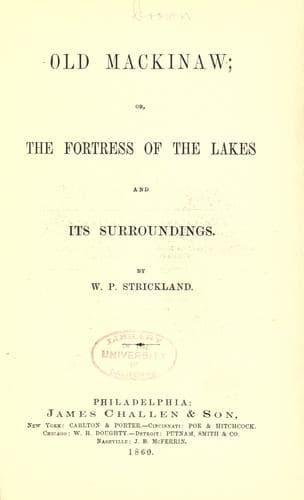
Old Mackinaw; Or, The Fortress of the Lakes and its SurroundingsStrickland, W. P. (William Peter)
History
Old Mackinaw; Or, The Fortress of the Lakes and its Surroundings
Strickland, W. P. (William Peter)
Great Lakes (North America); Mackinac Island (Mich. : Island) -- History; Michigan -- History
Michigan wants woolen and cotton, and various other factories to
provide employment for the over-crowded population of her cities and
villages, and to open a market for all her produce. The farmers of
Great Britain and Ireland could not pay the high rents and taxes which
are imposed on them, were it not for their proximity to the great
manufacturing cities of England. The cotton factories of Manchester,
the woolen factories of Leeds and Huddersfield, the hardware works of
Birmingham and Sheffield, and the potteries of Staffordshire, employ
hundreds of thousands of men, women, and children, who consume the
fruits of the soil, and create a steady demand for the farmer's stock
and grain. All these manufactures were fostered by protective laws
until they had attained a magnitude and importance which enabled them
to protect themselves by the wealth of their proprietors and the
excellence of their products. Large cities always afford a market for
farm produce, and on this account exert a very beneficial influence on
agriculture. The population of London is about two and a half
millions, and they are possessed of so much wealth, and are so
fastidious in their requirements, that almost every part of the world
contributes to supply them with the necessaries or luxuries of life.
The rapid growth of the cities of Michigan afford a home market for
the fruits of the soil. A great deal of land in the old
settlements of this State has been exhausted by a too frequent
repetition of the wheat crop, and is now being employed as pasture for
sheep and cattle. After remaining in grass for a few years, this land
will be in excellent condition for producing wheat, especially when
fertilized with that plentiful supply of barn-yard dung which the
raising of stock always produces.
There are some varieties of wheat which are much better suited to the
climate and soil of Michigan than others, as they are in a great
measure able to withstand the combined attacks of wheat insects and
the various diseases to which the plant is liable. These are now fast
supplanting the worn out grain, and as every malady has its cure or
preventive, it is probable that the introduction of the best kind of
seeds, the alternation between grass and tillage, and the supply of
rich manure which the raising of stock creates will have a very great
tendency to improve the wheat crop of this State.
It is remarkable fact although the wheat crop has rather declined in
the majority of States, the corn crop has steadily increased in all of
them. Thus in 1840, the entire corn crop of the United States amounted
to 400,000,000 of bushels; in 1850 it was nearly 600,000,000, of
bushels. The crop of 1855 was between 7 and 800,000,000 and that of
1858 was fully 800,000,000 of bushels. Taking into consideration
the large breath of land planted in 1859 and the damage by frost, we
might with safety set down the crop as amounting to 800,000,000
bushels.
Public-domain text, read in full here on John Shaqi.
Reviews
Reviews
No reviews yet
Be the first to share your thoughts on this work.
Elsewhere in the archive
Join the Discussion
Join the discussion
Sign in to leave a comment or review.
Sign InorCreate an account