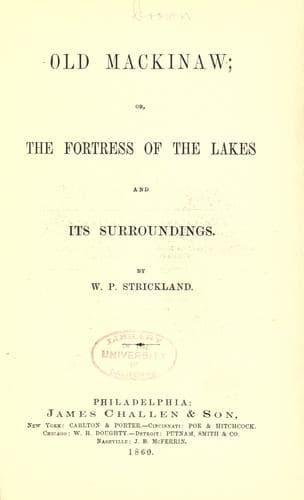
Old Mackinaw; Or, The Fortress of the Lakes and its SurroundingsStrickland, W. P. (William Peter)
History
Old Mackinaw; Or, The Fortress of the Lakes and its Surroundings
Strickland, W. P. (William Peter)
Great Lakes (North America); Mackinac Island (Mich. : Island) -- History; Michigan -- History
On the line of Amboy, Lansing, and Grand Traverse Railroad, the entire
distance from Owasso to Lansing, twenty-six miles, is ready for the
iron, except three miles. On the division from Lansing to Albion,
thirty-six miles, the work of grading and furnishing ties is
progressing, and some one hundred men at work. Between Owasso and
Saginaw, thirty-three miles, arrangements are nearly completed to
start the work. The work of grading and preparing for the iron is
done by local subscriptions, of which $3,000 per mile has been
subscribed and is being paid.
The existence of copper on the shores of Lake Superior appears to have
been known to the earliest travelers, but it has been only a few years
since it has entered largely into Western commerce. But the country
had long been a favorite resort for fur traders, and as long ago as
1809, and perhaps still further back, the Northwest Company (British)
owned vessels on Lake Superior. This organization was at that period
the great trading company of the region in question, the operations of
the Hudson's Bay Company being confined chiefly to the region further
north. At the period of which we speak, the bulk of the trading was
done by means of birch canoes, some of them large enough to carry two
or three tons. With these, the traders passed up to the Indian
settlements in the fall, with goods, provisions, and trinkets, usually
returning to the trading posts during the month of June with the furs
which they had procured in exchange. Mackinac and the Saut were
trading posts at an early day. At a somewhat later period, the
Northwest Company had an agency on an island in Lake Huron, not far
from the month of Saut river. The formation of the American Fur
Company was of more recent date, that company dating its origin during
the war of 1812, or soon after.
Prior to the building of the canal, a number of steamers had been
taken over the portage to Lake Superior, but so far as our knowledge
extends, only one or two craft larger than a canoe were ever taken
over the rapids, one of which was the schooner Mink. She was built of
red cedar, on Lake Superior, about the year 1816, and was of some
forty tons burden. She became the property of Mack & Conant, who had
her brought down the rapids. In making the descent she suffered some
injury by striking against a rock, but, notwithstanding this mishap,
she lived long enough to ride out many a stormy sea, running for
several years in the trade between Buffalo and the City of the
Straits. Shubael Conant, Esq., at this day an honored citizen of
Detroit, was one of the firm that purchased the Mink.
Public-domain text, read in full here on John Shaqi.
Reviews
Reviews
No reviews yet
Be the first to share your thoughts on this work.
Elsewhere in the archive
Join the Discussion
Join the discussion
Sign in to leave a comment or review.
Sign InorCreate an account