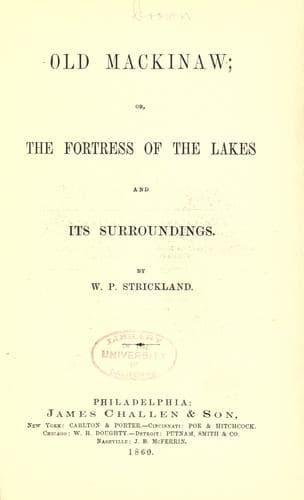
Old Mackinaw; Or, The Fortress of the Lakes and its SurroundingsStrickland, W. P. (William Peter)
History
Old Mackinaw; Or, The Fortress of the Lakes and its Surroundings
Strickland, W. P. (William Peter)
Great Lakes (North America); Mackinac Island (Mich. : Island) -- History; Michigan -- History
The copper interest of Michigan was first brought into public notice
by the enormous speculations and the mad fever of 1845. The large spur
of country which projects far out into the lake, having its base
resting on a line drawn across from L'Anse Bay to Ontonagon, and the
Porcupine Mountains for its spine, became the El Dorado of all
copperdom of that day. In this year the first active operations were
commenced at the Cliff Mine, just back of Eagle River harbor. Three
years later, in 1848, work was undertaken at the Minnesota, some
fifteen miles back from the lake at Ontonagon.
The history of the copper mines on Lake Superior shows that even the
best mines disappointed the owners in the beginning. We give the facts
relative to the three mines at present in the Lake Superior region to
illustrate this. The Cliff Mine was discovered in 1845, and worked
three years without much sign of success; it changed hands at the very
moment when the vein was opened which proved afterward to be so
exceedingly rich in copper and silver, producing now on an average
1,500 tons of stamp, barrel, and mass copper per annum.
The Minnesota Mine was discovered in 1848, and for the first three
years gave no very encouraging results. The first large mass of native
copper of about seven tons was found in a pit made by an ancient race.
After that discovery much money was spent before any other further
indications of copper were found. This mine yields now about 2,000
tons of copper per annum, and declared, for the year 1858, a net
dividend of $300,000. The dividends paid since 1852 amount to upward
of $1,500,000 on a paid-up capital of $66,000.
The same has been experienced at the Pewabic Mine. That mine commenced
operations in the year 1855, with an expenditure of $26,357, which
produced $1,080 worth of copper; the second year it expended $40,820,
and produced $31,492 of copper; in 1857 $24,484 of expenses produced
$44,058 worth of copper; 1858, the amount expended was $109,152, and
the receipts for copper $76,538; the total expense amounts to
$235,816, and the total receipts for copper to $153,168, leaving an
excess of expenses amounting to $82,648, which is, however, amply
covered by the extensive works established above and below ground at
the mine.
The Pewabic will undoubtedly take its place among the dividend-paying
mines of the present year.
Public-domain text, read in full here on John Shaqi.
Reviews
Reviews
No reviews yet
Be the first to share your thoughts on this work.
Elsewhere in the archive
Join the Discussion
Join the discussion
Sign in to leave a comment or review.
Sign InorCreate an account