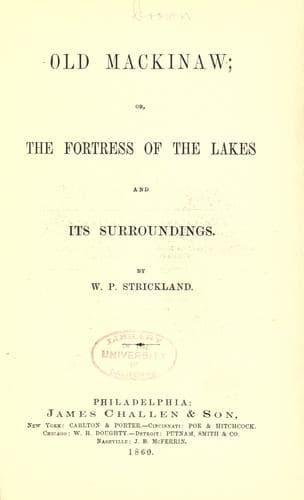
Old Mackinaw; Or, The Fortress of the Lakes and its SurroundingsStrickland, W. P. (William Peter)
History
Old Mackinaw; Or, The Fortress of the Lakes and its Surroundings
Strickland, W. P. (William Peter)
Great Lakes (North America); Mackinac Island (Mich. : Island) -- History; Michigan -- History
Marquette is the only point on Lake Superior where the iron ore
deposits have been worked. There are deposits of iron in the mountains
back of L'Anse, but this wonderful region leaves nothing more to be
desired for the present. At a distance of eighteen miles from the
lake, are to be found iron mountains named the Sharon, Burt, Lake
Superior, Cleveland, Collins, and Barlow, while eight miles further
back lie the Ely and St. Clair mountains. Three of these mountains are
at present worked, the Sharon, the Cleveland, and the Lake Superior,
and contain enough ore to supply the world for generations to come.
The mountains farther back embrace tracts of hundreds of acres rising
to a height of from four to six hundred feet, which, there is every
reason to believe, from the explorations made, are solid iron ore. The
extent of the contents of these mountains is perfectly fabulous, in
fact, so enormous as almost to baffle computation. The ore, too is
remarkably rich, yielding about seventy per cent. of pure metal. There
are now in operation at Marquette three Iron Mining Companies, and two
blast furnaces for making charcoal pig iron, the Pioneer and Meigs.
The Pioneer has two stacks and a capacity of twenty tons of pig iron
per day; the Meigs one stack, capable of turning out about eleven
tons. The Northern Iron Company is building a large bituminous coal
furnace at the mouth of the Chocolate River, three miles south of
Marquette, which will be in operation early in the summer.
Each of the mining companies, the Jackson, Cleveland and Lake
Superior, have docks at the harbor for shipment, extending out into
the spacious and beautiful bay which lies in front of Marquette to a
sufficient length to enable vessels of the largest dimension to lie by
their side and to be loaded directly from the cars, which are run over
the vessels and dumped into chutes, which are made to empty directly
into the holds. The process of loading is therefore very expeditious
and easy.
The amount of shipments of ore for 1859, from Marquette to the ports
below, reaches 75,000 gross tons in round numbers, and the shipments
of pig iron, 6,000 gross tons more. To this must be added the amount
at Marquette when navigation closed, the amount at the mines ready to
be brought down, and the amount used on the spot. This will give a
total product of the iron mines of Michigan for the past year of
between _ninety and one hundred thousand tons_. These mining companies
simply mine and ship the ore and sell it. Their profit ranges between
seventy-five cents and one dollar per ton.
The quality of the iron of Lake Superior is conceded by all to be the
best in the world, as the analysis of Prof. Johnson, which we
reproduce, shows. The table shows the relative strength per square
inch in pounds.
Public-domain text, read in full here on John Shaqi.
Reviews
Reviews
No reviews yet
Be the first to share your thoughts on this work.
Elsewhere in the archive
Join the Discussion
Join the discussion
Sign in to leave a comment or review.
Sign InorCreate an account