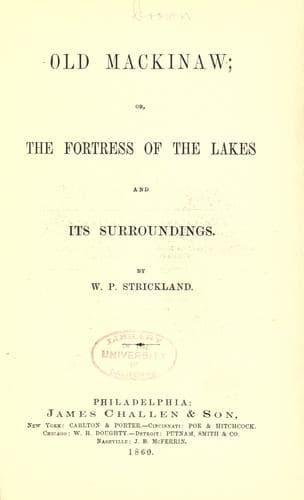
Old Mackinaw; Or, The Fortress of the Lakes and its SurroundingsStrickland, W. P. (William Peter)
History
Old Mackinaw; Or, The Fortress of the Lakes and its Surroundings
Strickland, W. P. (William Peter)
Great Lakes (North America); Mackinac Island (Mich. : Island) -- History; Michigan -- History
The fishing grounds of Michigan City are almost entirely within our
State. The number of barrels include those sold fresh as well as
salted, there being a considerable quantity of the former, in some of
the fisheries last named, Michigan City and New Buffalo especially,
from whence they are sent packed in ice to the different towns in
Michigan; also to Lafayette and Indianapolis, Indiana, to Louisville,
Kentucky, to Cincinnati, and also to Chicago, where they are repacked
in ice, and some of them find their way to St. Louis, Cairo, etc. From
St. Joseph and Grand Haven there are large quantities sent fresh to
Chicago and Milwaukee, where they are repacked in ice.
At a fair estimate for the few small fisheries on this coast from
which we have no return, together with those on the west coast of Lake
Michigan, they are worth at least $60,000, but we have no data by
which to form an estimate of the proportion packed.
The number of men employed, and the consequent expense, varies
according to the method employed. With seines the occupation is very
laborious, and requires a much stronger force than pound nets. One set
of hands can manage a number of the latter. Some of the fisheries on
Detroit and St. Clair rivers use seines altogether, to draw which,
horse-power is brought into requisition in some cases. A double set
of men are employed, working alternately day and night, and the
exposure is a most disagreeable feature of the business, particularly
in bad weather. The great bulk of the aggregate catch continues to be
taken with seines or gill nets, but pound (or trap) nets are on the
increase. They have been in use below Lake Huron more or less for the
past four or five years, but it is only about two years since their
introduction in the upper lakes. With these nets 100 barrels of
white-fish have been taken at a single haul. Of course their general
use must produce a material diminution in the supply.
As regards capital invested, there is in particular instances a wide
difference. George Clark, Esq., nine miles below Detroit, has $12,000
invested in his grounds, owing mostly to the cost of removing
obstructions. But this is an exception.
The barrels for packing constitute no inconsiderable item of this vast
and important trade. Their manufacture is a regular branch in Port
Huron, but most of them are made by the fishermen when not engaged in
their regular vocation. They are made at all the villages and fishing
stations on Lake Huron, pine being generally easy of access. The
barrels are worth 62-1/2 cents each; half-barrels, 50 cents. Over
two-thirds of the packages used are halves, but our estimated totals
of the catch represent wholes.
Formerly the nets used also to be made almost entirely by the
fishermen, who usually procured the twine from Detroit. Latterly, many
of them have been brought from Boston already made.
Public-domain text, read in full here on John Shaqi.
Reviews
Reviews
No reviews yet
Be the first to share your thoughts on this work.
Elsewhere in the archive
Join the Discussion
Join the discussion
Sign in to leave a comment or review.
Sign InorCreate an account