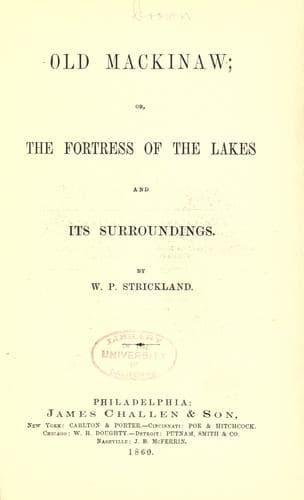
Old Mackinaw; Or, The Fortress of the Lakes and its SurroundingsStrickland, W. P. (William Peter)
History
Old Mackinaw; Or, The Fortress of the Lakes and its Surroundings
Strickland, W. P. (William Peter)
Great Lakes (North America); Mackinac Island (Mich. : Island) -- History; Michigan -- History
In 1828, the Baptists established a mission at Saut St. Mary. This
mission was opened under the most favorable auspices by the Rev. A.
Bingham, and continued in a state of prosperity for many years. In
1843 it was still under the superintendence of the Rev. Mr. Bingham,
who for twenty years had been laboring to bring the Indians under
Christian influence. Indian children were boarded in the mission
establishment, and a school was kept up, which, in the language of
one, would have been a credit to any land. The Rev. Mr. Porter, a
Congregationalist missionary, also labored here. The labors of these
missionaries were greatly blessed, and numbers of officers and
soldiers at the fort and garrison, as well as Indians, were converted.
The Baptist missionaries extended their labors to various points on
the northern peninsula and on the shores of Lake Superior.
The Methodists commenced a mission at Saut St. Mary, under the labors
of "John Sunday," a converted Indian, soon after that established by
the Baptists. In 1831 a portion of the Oneida Indians removed to Green
Bay, and the Rev. John Clark was sent out as a missionary among them
the following year. In a report made by the missionary to the Board,
he thus describes his field of labor: "The white settlement is located
on the left bank of the Fox River, extending up the river about five
miles from the head of the bay. The population is about one thousand,
but greatly amalgamated with the Menominee Indians, over whom it is
said they have great influence. The Indian settlement is about
twenty-five miles from this place, on the left bank of the Fox river."
Mr. Clark preached at this settlement and at Green Bay on alternate
Sabbaths. Messrs. Marsh and Stevens, of the Presbyterian church, were
located here, laboring among the Stockbridge Indians and kindly
welcomed Mr. Clark among them. These Indians emigrated from
Stockbridge, Mass., and were at one time under the pastoral care of
Jonathan Edwards. While this distinguished divine was missionary among
these Indians, at Stockbridge, he wrote his famous "Treatise on the
Will." Mr. Clark was cordially received by the Indian agent, Mr.
Schoolcraft.
In 1833, he visited Saut St. Mary, and found a revival in progress.
Nearly all the officers, and thirty or forty soldiers, in Fort Brady
had been converted. The command was soon after removed to Chicago, and
was succeeded by another. A gracious revival followed his labors at
the fort, and officers and soldiers were seen bowing at the same
altar, happy in the enjoyment of a common salvation. Still holding his
connection with Green Bay, he visited that place and preached in Fort
Howard and also among his Indians who had removed to Duck Creek.
Public-domain text, read in full here on John Shaqi.
Reviews
Reviews
No reviews yet
Be the first to share your thoughts on this work.
Elsewhere in the archive
Join the Discussion
Join the discussion
Sign in to leave a comment or review.
Sign InorCreate an account