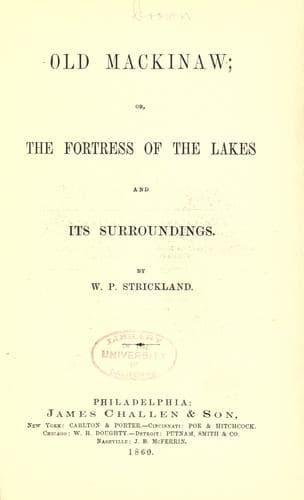
Old Mackinaw; Or, The Fortress of the Lakes and its SurroundingsStrickland, W. P. (William Peter)
History
Old Mackinaw; Or, The Fortress of the Lakes and its Surroundings
Strickland, W. P. (William Peter)
Great Lakes (North America); Mackinac Island (Mich. : Island) -- History; Michigan -- History
"A friend of mine, now residing in western Michigan, and who once
spent several years in Europe, thus writes respecting this region:
"'Oh, such trees as we have here! Magnificent, tall, large-leafed,
umbrageous. Vallombrosa, the far-famed Vallombrosa of Tuscany, is
nothing to the thousand Vallombrosas here! A fig for your Italian
scenery! This is the country where nature reigns in her virgin beauty;
where trees grow, where corn grows; where men grow better than they do
anywhere else in the world. This is the land to study nature in all
her luxuriant charms, under glorious green branches, among singing
birds and laughing streams; this is the land to hear the cooing of the
turtle-dove, in far, deep, cool, sylvan bowers; to feel your soul
expand under the mighty influences of nature in her primitive beauty
and strength.'
"The principal inland rivers of Michigan, are the Grand River, the
Kalamazoo, the St. Joseph, the Saginaw, and the Raisin. The first
three empty into Lake Michigan, and are about seventy miles apart.
Their average length is about two hundred and fifty miles, and they
are about thirty or forty rods in width. At present, they are
navigable about half their length for small steamboats and bateaux.
Their bed is of limestone, covered with pebbles. I was a passenger on
board the Matilda Barney, on her first trip,--the first steamer that
ever ascended the St. Joseph, which I consider the most perfectly
beautiful stream that I ever have seen. I remember well the many
flocks of wild turkeys and herds of deer that the 'iron horse'
frightened in his winding career. The Indian canoe is now giving way
to the more costly but less beautiful row-boat, and those rivers are
becoming deeper and deeper every day. Instead of the howl of the wolf,
the songs of husbandmen now echo through their vales, where may be
found many comfortable dwellings.
"The Saginaw runs toward the north and empties into Lake Huron,--that
same Huron which has been celebrated in song by the young poet, Louis
L. Noble. This river is navigable for sixty miles. The river Raisin is
a winding stream, emptying into Lake Erie, called so from the quantity
of grapes that cluster on its banks. Its Indian name is Nummasepee,
signifying River of Sturgeons. Sweet river! whose murmurs have so
often been my lullaby, mayst thou continue in thy beauty forever. Are
there not streams like thee flowing through the paradise of God?
Public-domain text, read in full here on John Shaqi.
Reviews
Reviews
No reviews yet
Be the first to share your thoughts on this work.
Elsewhere in the archive
Join the Discussion
Join the discussion
Sign in to leave a comment or review.
Sign InorCreate an account