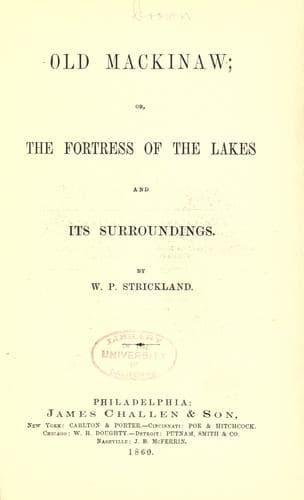
Old Mackinaw; Or, The Fortress of the Lakes and its SurroundingsStrickland, W. P. (William Peter)
History
Old Mackinaw; Or, The Fortress of the Lakes and its Surroundings
Strickland, W. P. (William Peter)
Great Lakes (North America); Mackinac Island (Mich. : Island) -- History; Michigan -- History
"It must be granted, at once, that for any water communication with
the ports of the Atlantic, Mackinaw has greatly the advantage over any
commercial point in Minnesota, Wisconsin, Northern Illinois, Northern
Michigan, or Northwest Canada. How great this advantage is, we shall
see from the consideration of the surface drained by the water
current of Mackinaw. An inspection of the map will show that from Long
Lake, above latitude 50 deg., to the south end of Lake Michigan, below
latitude, 40 deg., and from the Lake of the Woods, longitude 95 deg., to
Saginaw Bay, longitude 83 deg., the country is entirely within the
drainage of lakes and river whose currents concentrate at the Straits
of Mackinaw. This surface comprehends a square of over six hundred
miles on the side, or nearly four hundred thousand square miles.
Deducting the surface of the lakes, it is enough to make eight States
as large as Ohio. In that whole surface, there is not a single point
which can rival Mackinaw as a point of _distribution for the products
of that country_. That the advantage by water lines is in favor of
Mackinaw, we have shown. That it will be equally so by railroad, is
evident, from the fact that Mackinaw city to Port Huron, and thence to
Buffalo, need not exceed four hundred miles, while that from Chicago
to Buffalo, in a direct line is five hundred and fifteen miles.
"From any other point of Lakes Michigan or Superior, where a city can
be built, it is further. Mackinaw is, therefore, the natural centre of
drainage and distribution for a surface equal to that of eight large
States, and whose products, whether of field, fruit, or mines, are
superabundant in whatever creates commerce, sustains population, or
affords the materials of industry.
"We are now considering Mackinaw in a state of nature, and must look
to its natural products as the first and greatest elements of success.
We have considered its climate, its water currents, its lines of
navigation, and the surface drainage for its support. The latter
within a space where there can be no competition, we have found to be
but little less than 400,000 square miles. Vast as this is, it could
not support a great commercial city, if that were a barren plain.
"Hence, we must now consider how far the products of the earth will
sustain the city, which such lines of navigation, such means of
commerce, and such an extensive, surface leads us to anticipate.
Public-domain text, read in full here on John Shaqi.
Reviews
Reviews
No reviews yet
Be the first to share your thoughts on this work.
Elsewhere in the archive
Join the Discussion
Join the discussion
Sign in to leave a comment or review.
Sign InorCreate an account