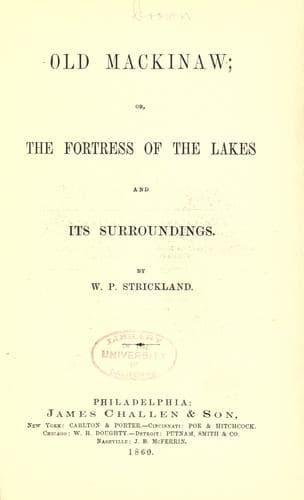
Old Mackinaw; Or, The Fortress of the Lakes and its SurroundingsStrickland, W. P. (William Peter)
History
Old Mackinaw; Or, The Fortress of the Lakes and its Surroundings
Strickland, W. P. (William Peter)
Great Lakes (North America); Mackinac Island (Mich. : Island) -- History; Michigan -- History
"Of Minnesota, and its productiveness, less is known. As three-fourths
of that rich and beautiful country, and the regions around the heads
of the Mississippi, must contribute to the commercial importance of
Mackinaw, let us glance at its agricultural capacity and prospects.
Minnesota, of which we heard but yesterday, has now two hundred
thousand inhabitants, produces this year two millions of bushels of
wheat. St. Paul, its principal town has fourteen thousand inhabitants,
and far to the northwest from St. Peters to the Red River, and
Assinibone, the settlers are crowding in to till farms and create
towns, where but recently the wild wolf and the wilder savage, alone
possessed the face of the earth. In latitudes higher than that of
Mackinaw, Michigan or Canada West, settlements are forming, and it
requires no flight of imagination to see that beautiful land of lakes,
rivers, forests, and prairies,--cold as it may be in winter--settled,
tilled, and civilized. The fact of its rapid progress in population,
is sufficient proof of its agricultural capacity; but we shall again
refer to the testimony of actual observers. Turning to Mr. Ferris's
first description of the Northwest, we find his summing of the
climate, and agricultural advantages of Upper Minnesota. 'Minnesota is
destined to become a great agricultural, and grazing region. Its
upland and lowland plains would support a dairy that would enrich an
empire. All the principal grains, and roots thrive there in great
vigor, as high toward the north as Pembina, below the dividing line
between the United States and British America. Latitude does not
always indicate the climate as has already been shown. The character
of the soil has great influence upon the temperature of the air. A
quick warm soil makes a warm atmosphere. The autumns of Minnesota are
greatly lengthened out by the Indian summer, that smoky, dreary, balmy
season, which protects the surface from frost, like a mantle flung
upon the earth. The cold nips the vegetation, about as early along the
Ohio, as along the St. Peters. The winters of Minnesota are cold; but
then they are still and calm, and the icy air does not penetrate, as
it does in a windy climate.'
"In the brief review of the agricultural advantages of that great
northwestern region, whose centre of commerce must ever be at
Mackinaw; we have arrived at the certain fact, that except small
portions of the Superior country, where mining and mines absorb all
other interests, no country in the northern part of America or Europe,
has greater advantages. It is filled with inexhaustible springs, and
streams; fertile in soil, rich in production, and only needs the
cultivating hand of man, to render it capable of sustaining such dense
populations as now inhabit the same isothermal parallel in Prussia and
Poland.
Public-domain text, read in full here on John Shaqi.
Reviews
Reviews
No reviews yet
Be the first to share your thoughts on this work.
Elsewhere in the archive
Join the Discussion
Join the discussion
Sign in to leave a comment or review.
Sign InorCreate an account