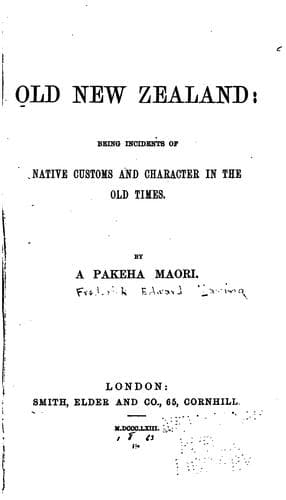
Old New Zealand: Being Incidents of Native Customs and Character in the Old TimesManing, Frederick Edward
History
Old New Zealand: Being Incidents of Native Customs and Character in the Old Times
Maning, Frederick Edward
Māori (New Zealand people); New Zealand -- Description and travel
I have stated that the worst part of the punishment of an offence
against this form of the _tapu_ was imaginary; but in truth, though
imaginary, it was not the less a severe punishment. "Conscience makes
cowards of us all," and there was scarcely a man in a thousand, _if_
one, who had sufficient resolution to dare the shadowy terrors of the
_tapu_. I actually have seen an instance where the offender, though an
involuntary one, was killed stone dead in six hours, by what I
considered the effects of his own terrified imagination; but what all
the natives at the time believed to be the work of the terrible avenger
of the _tapu_. The case I may as well describe, as it was a strong one,
and shows how, when falsehoods are once believed, they will meet with
apparent proof from accidental circumstances.
A chief of very high rank, standing, and _mana_, was on a war
expedition; with him were about five hundred men. His own personal
_tapu_ was increased twofold, as was that of all the warriors who were
with him, by the _war tapu_. The _taua_ being on a very dangerous
expedition, they were, over and above the ordinary personal _tapu_,
made sacred in the highest degree, and were obliged to observe strictly
several mysterious and sacred customs; some of which I may have to
explain by-and-by. They were, in fact, as irreverent pakehas used to
say, "tabooed an inch thick;" and as for the head chief, he was
perfectly unapproachable. The expedition halted to dine. The portion of
food set apart for the chief, in a neat _paro_ or shallow basket of
green flax leaves, was, of course, enough for two or three men, and
consequently the greater part remained unconsumed. The party, having
dined, moved on; and soon after a party of slaves and others, who had
been some mile or two in the rear, came up, carrying ammunition and
baggage. One of the slaves, a stout hungry fellow, seeing the chief's
unfinished dinner, ate it up before asking any questions. He had hardly
finished, when he was informed by a horror-stricken individual--another
slave who had remained behind when the _taua_ had moved on--of the
fatal act he had committed. I knew the unfortunate delinquent well: he
was remarkable for courage, and had signalized himself in the wars of
the tribe. (The able-bodied slaves are always expected to fight in the
quarrels of their masters; to do which they are nothing loth.) No
sooner did he hear the fatal news than he was seized with the most
extraordinary convulsions and cramps in the stomach, which never ceased
till he died, about sundown the same day. He was a strong man, in the
prime of life; and if any pakeha free-thinker should have said he was
not killed by the _tapu_ of the chief, which had been communicated to
the food by contact, he would have been listened to with feelings of
contempt for his ignorance and inability to understand plain and direct
evidence.
Public-domain text, read in full here on John Shaqi.
Reviews
Reviews
No reviews yet
Be the first to share your thoughts on this work.
Elsewhere in the archive
Join the Discussion
Join the discussion
Sign in to leave a comment or review.
Sign InorCreate an account