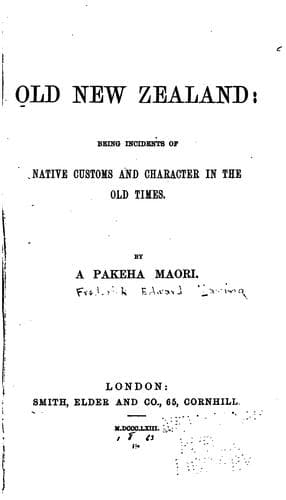
Old New Zealand: Being Incidents of Native Customs and Character in the Old TimesManing, Frederick Edward
History
Old New Zealand: Being Incidents of Native Customs and Character in the Old Times
Maning, Frederick Edward
Māori (New Zealand people); New Zealand -- Description and travel
This same personal _tapu_ would even hold its own in some cases against
the _muru_; though not in a sufficiently general manner to seriously
affect the operation of that well-enforced law. Its inconveniences
were, on the other hand, many, and the expedients resorted to to avoid
them were sometimes comical enough. I was once going on an excursion
with a number of natives; we had two canoes, and one of them started a
little before the other. I was with the canoe which had been left
behind, and just as we were setting off it was discovered that amongst
twenty stout fellows my companions there was no one who had a back!--as
they expressed it: consequently there was no one to carry our
provisions into the canoe. All the lads, women, and slaves had gone off
in the other canoe,--all those who had backs,--and so there we were
left, a very disconsolate lot of _rangatira_, who could not carry their
own provisions into the canoe, and who at the same time could not go
without them. The provisions consisted of several heavy baskets of
potatoes, some dried sharks, and a large pig baked whole. What was to
be done? We were all brought to a full stop, though in a great hurry to
go on. We were beginning to think we must give up the expedition
altogether, and were very much disappointed accordingly, when a clever
fellow--who, had he been bred a lawyer, would have made nothing of
driving a mail coach through an act of parliament--set us all to rights
in a moment. "I'll tell you what we must do," said he, "we will not
carry (_pikau_) the provisions, we will _hiki_ them." (_Hiki_ is the
word in Maori which describes the act of carrying an infant in the
arms.) This was a great discovery! A huge handsome fellow seized on the
baked pig and dandled it, or _hiki'd_ it, in his arms like an infant;
another laid hold of a shark, others took baskets of potatoes, and
carrying them in this way deposited them in the canoe. And so, having
thus evaded the law, we started on our expedition.
I remember another amusing instance in which the inconvenience arising
from the _tapu_ was evaded. I must, however, notice that these
instances were only evasions of the ordinary kind of _tapu_,--what I
have called the personal _tapu_; not the more dangerous and dreadful
kind connected with the mystic doings of the _tohunga_, or that other
form of _tapu_ connected with the handling of the dead. Indeed, my
companions in the instance I have mentioned, though all _rangatira_,
were young men on whom the personal _tapu_ had not arrived at the
fullest perfection: it seemed, indeed, sometimes to sit very lightly on
them, and I doubt very much if the play upon the words _hiki_ and
_pikau_ would have reconciled any of the elders of the tribe to
carrying a roasted pig in their arms; or, if they did do so, I feel
quite certain that no amount of argument would have persuaded the
younger men to eat it: as for slaves or women, to _look_ at it would
almost be dangerous to them.
Public-domain text, read in full here on John Shaqi.
Reviews
Reviews
No reviews yet
Be the first to share your thoughts on this work.
Elsewhere in the archive
Join the Discussion
Join the discussion
Sign in to leave a comment or review.
Sign InorCreate an account