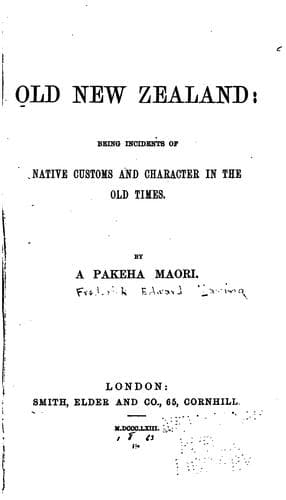
Old New Zealand: Being Incidents of Native Customs and Character in the Old TimesManing, Frederick Edward
History
Old New Zealand: Being Incidents of Native Customs and Character in the Old Times
Maning, Frederick Edward
Māori (New Zealand people); New Zealand -- Description and travel
Talking of bygone habits and customs of the natives, I remember I have
mentioned two cases of suicide. I shall, therefore, now take occasion
to state that no more marked alteration in the habits of the natives
has taken place than in the great decrease of cases of suicide. In the
first years of my residence in the country, it was of almost daily
occurrence. When a man died, it was almost a matter of course that his
wife, or wives, hung themselves. When the wife died, the man very
commonly shot himself. I have known young men, often on the most
trifling affront or vexation, shoot themselves; and I was acquainted
with a man who, having been for two days plagued with the toothache,
cut his throat with a very blunt razor, without a handle: which
certainly was a radical cure. I do not believe that one case of suicide
occurs now, for twenty when I first came into the country. Indeed, the
last case I have heard of in a populous district, occurred several
years ago. It was rather a remarkable one. A native owed another a few
shillings; the creditor kept continually asking for it; but the debtor,
somehow or other, never could raise the cash. At last being out of
patience, and not knowing anything of the Insolvent Court, he loaded
his gun, went to the creditor's house, and called him out. Out came the
creditor and his wife. The debtor then placed the gun to his own
breast, and saying, "Here is your payment," pulled the trigger with his
foot, and fell dead before them. I think the reason suicide has become
so comparatively unfrequent is, that the minds of the natives are now
filled and agitated by a flood of new ideas, new wants and ambitions,
which they knew not formerly, and which prevents them, from one single
loss or disappointment, feeling as if there was nothing more to live
for.
CHAPTER XII.
The Tapa.--Instances of.--The Storming of Mokoia.--Pomare.--Hongi
Ika.--Tareha.--Honour amongst Thieves.
There was a kind of variation on the _tapu_, called _tapa_, of this
nature. For instance, if a chief said, "That axe is my head," the axe
became his to all intents and purposes; except, indeed, the owner of
the axe was able to break his "head," in which case, I have reason to
believe, the _tapa_ would fall to the ground. It was, however, in a
certain degree necessary to have some legal reason, or excuse, for
making the _tapa_; but to give some idea of what constituted the
circumstances under which a man could fairly _tapa_ anything, I must
needs quote a case in point.
Public-domain text, read in full here on John Shaqi.
Reviews
Reviews
No reviews yet
Be the first to share your thoughts on this work.
Elsewhere in the archive
Join the Discussion
Join the discussion
Sign in to leave a comment or review.
Sign InorCreate an account