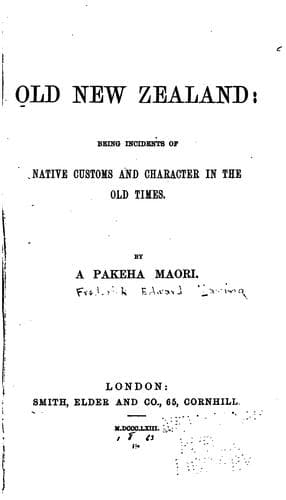
Old New Zealand: Being Incidents of Native Customs and Character in the Old TimesManing, Frederick Edward
History
Old New Zealand: Being Incidents of Native Customs and Character in the Old Times
Maning, Frederick Edward
Māori (New Zealand people); New Zealand -- Description and travel
Now an ancient knight of romance, under similar awkward circumstances,
would probably have retired from public life, sought out some forest
cave, where he would have hung up his armour, let his beard grow,
flogged himself twice a day "regular," and lived on "pulse"--which I
suppose means pea-soup--for the rest of his life. But my old
_rangatira_ and his companions had not a morsel of that sort of romance
about them. The killing of my friend's father was looked upon as a very
clever exploit in itself; though a very unlucky one. So after having
scolded one another for some time--one party telling the other they
were served right for not keeping a better look out, and the other
answering that they should have been sure who they were going to attack
before making the onset--they all held a _tangi_ or lamentation for the
old warrior who had just received his _mittimus_; and then killing a
prisoner, whom they had brought in the canoes for fresh provisions,
they had a good feast; after which they returned all together to their
own country, taking the body of their lamented relative along with
them. This happened many years before I came to the country, and when
my _rangatira_ was one of the most famous fighting-men in his tribe.
This Maori _rangatira_ I am describing had passed his whole life, with
but little intermission, in scenes of battle, murder, and bloodthirsty
atrocities of the most terrific description; mixed with actions of the
most heroic courage, self-sacrifice, and chivalric daring, as leaves
one perfectly astounded to find them the deeds of one and the same
people: one day doing acts which, had they been performed in ancient
Greece, would have immortalized the actors, and the next committing
barbarities too horrible for relation, and almost incredible.
The effect of a life of this kind was observable plainly enough, in my
friend. He was utterly devoid of what weak mortals call "compassion."
He seemed to have no more feeling for the pain, tortures, or death of
others than a stone. Should one of his family be dying or wounded, he
merely felt it as the loss of one fighting man. As for the death of a
woman, or any non-combatant, he did not feel it at all; though the
person might have suffered horrid tortures: indeed I have seen him
scolding severely a fine young man, his near relative, when actually
expiring, for being such a fool as to blow himself up by accident, and
deprive his family of a fighting man. The last words the dying man
heard were these:--"It serves you right. There you are, looking very
like a burnt stick! It serves you right--a burnt stick! Serves you
right!" It really _was_ vexatious. A fine stout young fellow to be
wasted in that way.
Public-domain text, read in full here on John Shaqi.
Reviews
Reviews
No reviews yet
Be the first to share your thoughts on this work.
Elsewhere in the archive
Join the Discussion
Join the discussion
Sign in to leave a comment or review.
Sign InorCreate an account