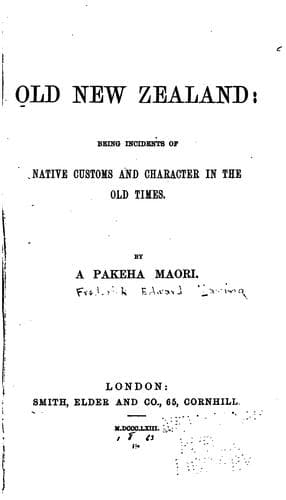
Old New Zealand: Being Incidents of Native Customs and Character in the Old TimesManing, Frederick Edward
History
Old New Zealand: Being Incidents of Native Customs and Character in the Old Times
Maning, Frederick Edward
Māori (New Zealand people); New Zealand -- Description and travel
These little fire-places, and the scarped and terraced conical hills,
are the only mark the Maori of ancient times have left of their
existence. And I have reasons for believing that this country has been
inhabited from a more remote period by far than is generally supposed.
These reasons I found upon the dialect of the Maori language spoken by
the Maori of New Zealand, as well as on many other circumstances.
We may easily imagine that a hill of this kind, covered from bottom to
top with houses thatched and built of reeds, rushes, and raupo, would
be a mere mass of combustible matter; and such indeed was the case.
When an enemy attacked one of these places, a common practice was to
shower into the place, from slings, red-hot stones, which, sinking into
the dry thatch of the houses, would cause a general conflagration.
Should this once occur the place was sure to be taken. This mode of
attack was consequently much feared; all hands not engaged at the outer
defences, and all women and non-combatants, being employed guarding
against this danger, by pouring water out of calabashes on every smoke
that appeared. The natives also practised both mining and escalade in
attacking a hill fort.
The natives attribute their decrease in numbers, before the arrival of
the Europeans, to war and sickness; disease possibly arising from the
destruction of food and the forced neglect of cultivation caused by the
constant and furious wars which devastated the country for a long
period before the arrival of the Europeans: and to such an extent that
the natives at last believed a constant state of warfare to be the
natural condition of life, and their sentiments, feelings, and maxims
became gradually formed on this belief. Nothing was so valuable or
respectable as strength and courage, and to acquire property by war and
plunder was more honourable and also more desirable than by labour.
Cannibalism was glorious. In a word, the island was a pandemonium.
A rugged wight, the worst of brutes, was man;
On his own wretched kind he ruthless prey'd.
The strongest then the weakest overran,
In every country mighty robbers sway'd,
And guile and ruffian force was all their trade.
Since the arrival of the Europeans the decrease of the natives has also
been rapid. In that part of the country where I have had means of
accurate observation, they have decreased in number since my arrival
rather more than one-third. I have, however, observed that this
decrease has for the last ten years been very considerably checked;
though I do not believe this improvement is general through the
country, or even permanent where I have observed it.
Public-domain text, read in full here on John Shaqi.
Reviews
Reviews
No reviews yet
Be the first to share your thoughts on this work.
Elsewhere in the archive
Join the Discussion
Join the discussion
Sign in to leave a comment or review.
Sign InorCreate an account