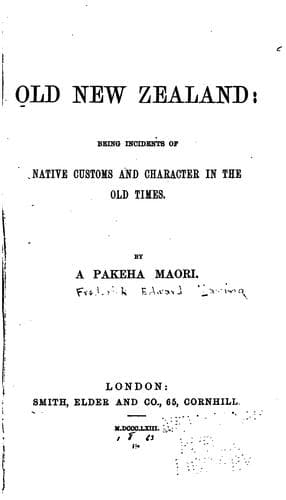
Old New Zealand: Being Incidents of Native Customs and Character in the Old TimesManing, Frederick Edward
History
Old New Zealand: Being Incidents of Native Customs and Character in the Old Times
Maning, Frederick Edward
Māori (New Zealand people); New Zealand -- Description and travel
Now when the natives became generally armed with the musket they at
once abandoned the hills, and, to save themselves the great labour and
inconvenience occasioned by the necessity of continually carrying
provisions, fuel, and water to these precipitous hill-castles--which
would be also, as a matter of necessity, at some inconvenient distance
from at least some part of the extensive cultivations--descended to the
low lands, and there, in the centre of the cultivations, erected a new
kind of fortification adapted to the capabilities of the new weapon.
_This_ was their destruction. For they built their oven-like houses in
mere swamps, where the water, even in summer, sprang with the pressure
of the foot, and where in winter the houses were often completely
flooded. There, lying on the spongy soil, on beds of rushes which
rotted under them--in little low dens of houses, or kennels, heated
like ovens at night and dripping with damp in the day--full of noxious
exhalations from the damp soil, and impossible to ventilate--they were
cut off by disease in a manner absolutely frightful. No advice would
they take: they could not _see_ the enemy which killed them, and
therefore could not believe the Europeans who pointed out the cause of
their destruction.
This change of residence was universal, and everywhere followed by the
same consequences, more or less marked: the strongest men were cut off
and but few children were reared. And even now, after the dreadful
experience they have had, and all the continual remonstrances of their
pakeha friends, they take but very little more precaution in choosing
sites for their houses than at first; and when a native village or a
native house happens to be in a dry healthy situation, it is often more
the effect of accident than design.
Twenty years ago a _hapu_, in number just forty persons, removed their
_kainga_ from a dry healthy position to the edge of a _raupo_ swamp. I
happened to be at the place a short time after the removal, and with me
there was a medical gentleman who was travelling through the country.
In creeping into one of the houses (the chief's) through the low door,
I was obliged to put both my hands to the ground; they both sank into
the swampy soil, making holes which immediately filled with water. The
chief and his family were lying on the ground on rushes, and a fire was
burning, which made the little den, not in the highest place more than
five feet high, feel like an oven. I called the attention of my friend
to the state of this place called a "house." He merely said, "_men_
cannot live here." Eight years from that day the whole _hapu_ were
extinct; but, as I remember, two persons were shot for bewitching them
and causing their deaths.
Public-domain text, read in full here on John Shaqi.
Reviews
Reviews
No reviews yet
Be the first to share your thoughts on this work.
Elsewhere in the archive
Join the Discussion
Join the discussion
Sign in to leave a comment or review.
Sign InorCreate an account