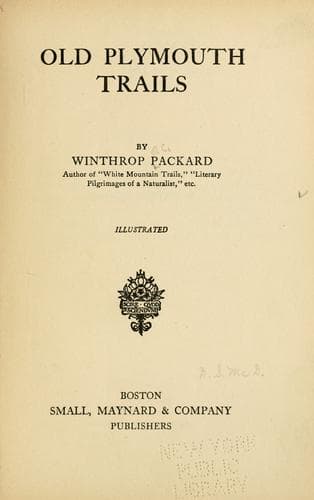
Natural history -- Massachusetts; Natural history -- Outdoor books; Plymouth County (Mass.)
To us in New England to whom a cedar tree thirty feet high is no
common sight the stories of these hundred-foot high trees seem
strange indeed, and I know of but one red cedar whose diameter is
as much as twelve inches. This tree is much less than thirty feet
in height, however. It grows by itself on rocky ground in a
pasture where it has no close neighbors of any variety. Its trunk
divides at eight feet from the ground into many branches which
make a round head whose ancient, twigs are hoary with lichens and
seem to be in the last stages of senile debility. Yet every year
the old tree puts forth a crop of new leaves and defies the decay
of centuries. How many years old this tree is I cannot say, but I
think it very many. We readily tell the age of many trees by
counting the rings of growth after they are cut. Cedars have been
known to show an annual increase of half to three-quarters of an
inch thus measured. Others have grown so slowly that only with a
microscope can the annual rings be counted. I fancy my patriarch
as belonging to their lodge, nor would I be surprised to learn
that when its first plume appeared above the ledges Indian tepees
were the only human habitations of the region.
The red cedar seems to have a power to fix itself on a rough ledge
and grow there year after year and indeed century after century,
that is far greater than that of any other tree. You will find
them on the rocks looking seaward along much of our New England
coast, some of them the same trees known in the same spots since
the days of the earliest settlers, gnarled, stunted and storm-beaten,
but evergreen, and glowing with a little of the gold of spring
each year just the same, typical, it always seems to me,
of all that is hardy and defiant in the New England character.
I know such cedars on the ledges which jut southerly from
the edge of the tiny plateau which is the top of Blue Hill
and you may find them on many other ledges of the range. I believe
these same trees were there when Captain John Smith first sighted
the "Cheviot Hills" from the ship which brought him into
Massachusetts Bay.
Public-domain text, read in full here on John Shaqi.
Reviews
Reviews
No reviews yet
Be the first to share your thoughts on this work.
Elsewhere in the archive
Join the Discussion
Join the discussion
Sign in to leave a comment or review.
Sign InorCreate an account