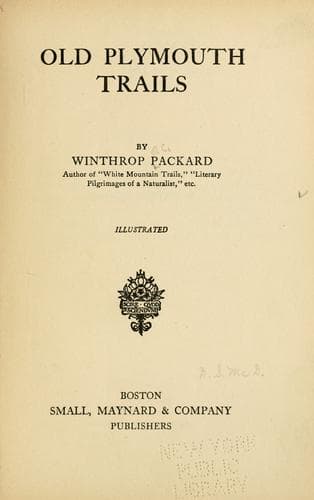
Natural history -- Massachusetts; Natural history -- Outdoor books; Plymouth County (Mass.)
Sitting in the silence and the sun as the fire smoulders to gray
ashes one may take stock of the birds of the woods by ear and eye.
In the still air all sounds carry far. The cawing of the crows
rings a mile across the tree tops, but these are the only winter
birds one may hear far in the full sunshine. The bluejays, so
noisy in the autumn, are silent in midwinter. Rarely, indeed, at
the depth of winter do you hear one of them utter the clear,
clanging call of his race. But the wood holds them still, and as
the campfire burns low they are apt to come about it, knowing well
that beside deserted campfires scraps of food may be found. On
such expeditions they come on noiseless wing, whinnying one to
another in voices inaudible a few rods away. If one sees you he
may utter a single loud note of warning, but that will be all, and
the flock will scuttle away on noiseless wings as they came.
A nuthatch may come to perch upside down on a tree nearby, blowing
his elfin penny-trumpet note, a brown creeper may screep tinily or
a downy woodpecker knock gently at the doors of insects shut
within the rotten wood, but only the chickadees are noisy. Their
volubility is proof against the hush laid upon the forest by the
westering sun, and you can hear them sputtering their way through
the underbrush from afar. Birds in the wood mostly leave a trail
for the ear rather than the eye. On such a day, even in the cold
of January, you may hear a ruffed grouse drum. The seeping sun
warms the cockles of his heart and reminds him of the brown mates
of last spring, and he needs must hop up on the old log and drum
for them, though there is little chance that they will heed his
amorous call. The ruffed grouse has much brain even for a bird, as
his ability to live in our Massachusetts woods in spite of the
omnipresent huntsmen shows, but like the fox, he, too, sometimes
gets in a brown study and may allow you to meet him at a corner.
When this happens to me I am always surprised to see what a fine
dignity the bird has in the woods, unconscious of observation. His
carriage is that of a lord of the thicket, and he seems far larger
and taller than his bulk and length when put to the yardstick
would show. I always think his tracks in the snow show something
of the same characteristics, as if he unwittingly wrote his
character into his signature, as most of us do.
All in all it is a fine sport, this hunting of the wild creatures
of the wood without harming them. To bag them in one's memory or
one's notebook is to accomplish that feat long desired of mankind,
to keep one's cake and eat it too, while he who shoots kills his
joy in the acquiring of it.
Public-domain text, read in full here on John Shaqi.
Reviews
Reviews
No reviews yet
Be the first to share your thoughts on this work.
Elsewhere in the archive
Join the Discussion
Join the discussion
Sign in to leave a comment or review.
Sign InorCreate an account