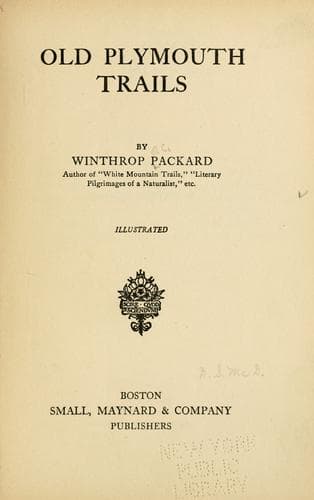
Natural history -- Massachusetts; Natural history -- Outdoor books; Plymouth County (Mass.)
In 1877 the first of this coasting was done by the English at St.
Moritz, and ever since the courses there have been steadily
improving, and "toboggans" as well. The final word has become a
skeleton frame of steel, the wooden runners being entirely removed
from within the shoe and the rider occupying a thin board hung
between the upper frames. The under part of the heavy steel runner
is grooved so as to grip the ice, and the whole "rocks" after the
style of the old-fashioned "rocker" skate. Thus on a curve the
rider, putting his weight aft is able to turn more rapidly without
the sled losing its grip on the ice beneath. On these the Swiss
coasters negotiate S curves at surprising speed, and are estimated
to reach sixty or even seventy miles an hour on the straight
stretches of the world-famous course. As might be supposed by any
one who coasts, this speed is not made with the rider sitting on
his sled girl fashion. Long ago the American visitors taught the
St. Moritz coasters that the way to ride a clipper sled on a swift
coast was to go "belly-bump," prone on one's belly, with a foot
ready to steer at the right or left as the case might be. The
stability is surer because the centre of gravity is lower, the
wind resistance is less, and the method is safer and better, if it
is not so dignified. The records made thus converted the most
phlegmatic Englishmen at St. Moritz, and since then this has been
the approved fashion.
But we have gone coasting a long way from Ponkapoag Hill. There,
long before the Swiss course was thought of the evolution in sleds
was going on, and though Ponkapoag did not evolve the steel-frame
skeleton coaster it got some tasty rigs of its own. Similar things
were brought out all over New England, I fancy, on all big hills
where Yankee boys coasted. One of these was the double-runner, or
double-ripper as it was sometimes called, rather ominously. I meet
double-runners on the hills sometimes now-a-days, but not the
leviathans of old. The beginning of this community coaster is
simple. It is two clipper sleds fastened together so that the rear
one runs in the tracks of the front one. Then came a board placed
lengthwise across the two and the double-runner was fairly begun.
Later this board came to be a long plank that would hold a dozen.
With that the capacity of the common clipper sled was reached. But
they did not stop at that at Ponkapoag. They built two big sleds
specially, shod them with proper steel runners at the local
blacksmith shop, and set high above them an enormous, stout plank
with foot rests and all sorts of modern conveniences.
Public-domain text, read in full here on John Shaqi.
Reviews
Reviews
No reviews yet
Be the first to share your thoughts on this work.
Elsewhere in the archive
Join the Discussion
Join the discussion
Sign in to leave a comment or review.
Sign InorCreate an account