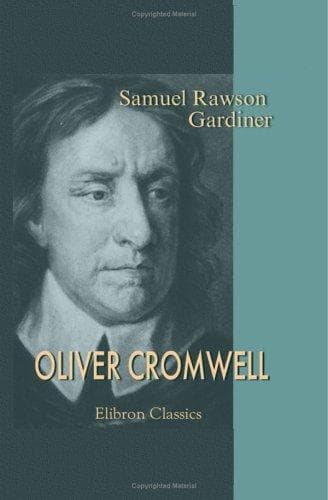
Cromwell, Oliver, 1599-1658; Great Britain -- History -- Commonwealth and Protectorate, 1649-1660
Under these circumstances, Cromwell's return had been ardently expected
by all who had attached themselves to the existing Government. Whilst
he was still absent, Parliament had secured to him the use of the
Cockpit--a house opposite Whitehall--and also of St. James's House and
Spring Gardens; and had afterwards voted to him an additional grant
of lands bringing in £2,500 a year. On June 1 he had a magnificent
reception as he crossed Hounslow Heath, and on the 4th received the
thanks of Parliament for his services. The first question mooted was
on whom should be bestowed the command of the army destined for the
north. As long as it was expected that the troops were to act on the
defensive, Fairfax was ready to go with Cromwell serving under him, as
in old days, as his Lieutenant-General.
On June 20, when it was resolved, doubtless at Cromwell's suggestion,
that the English army should invade Scotland to anticipate an attack
which was regarded as inevitable, Fairfax's hesitations began, and
after a brief delay he offered to resign his commission. Cromwell
did his best to combat his arguments, which proceeded rather from
a general feeling of distrust of the tendency of the Commonwealth
Government than from any distinct resolve to separate himself from it.
Cromwell's persuasions were of no avail, and on June 26 he received the
appointment of Lord General, which Fairfax was now permitted to resign.
Cromwell's mind was set on something more than military success. In
a conversation with Ludlow who was about to leave for Ireland, he
discoursed for an hour on the 110th Psalm. "He looked," he said, "on
the design of the Lord in this day to be the freeing of the people
from every burden." Especially he found hard words to fling at the
lawyers--those sons of Zeruiah who had hitherto stood in the way of the
simplifying of the law in favour of poorer litigants.
On June 28 Cromwell set out for his command. At Berwick on July 19 he
found himself at the head of 16,000 men, whilst the Scottish army,
under the command of David Leslie, numbered 26,000. For the first
time in his life Cromwell was opposed to a general who was a capable
strategist. The Scottish army, moreover, had the advantage of position.
Occupying Edinburgh Castle and the fortified city sloping eastwards
beneath it, Leslie had thrown up intrenchments from the foot of the
Canongate to Leith, to bar the way to any army threatening to cut off
the city from its port. Cromwell, having failed to carry this line,
retreated to Musselburgh to prepare for his next step.
Public-domain text, read in full here on John Shaqi.
Reviews
Reviews
No reviews yet
Be the first to share your thoughts on this work.
Elsewhere in the archive
Join the Discussion
Join the discussion
Sign in to leave a comment or review.
Sign InorCreate an account