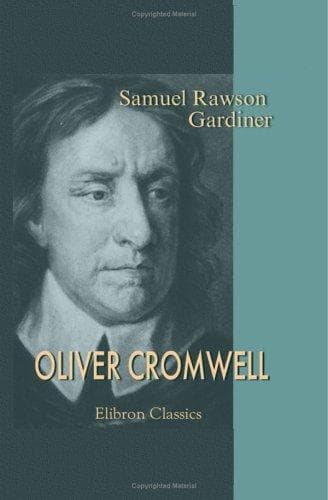
Cromwell, Oliver, 1599-1658; Great Britain -- History -- Commonwealth and Protectorate, 1649-1660
Unfortunately for Cromwell the circumstances were not the same. It
is unnecessary here to discuss the relative merits of written and
unwritten constitutions on the one hand, or of a dominant Parliament
and a dominant executive on the other. The one form of government or
the other may be desirable in different nations or at different times.
The one thing needful is that the institutions of a nation, whatever
they be, shall be supported by the national sentiment. It was this
that Oliver had never succeeded in evoking, because he had never
appealed to it, and he was hardly likely to succeed in evoking it now.
He could, for a time--and only for a time--rule England with an army.
He could not rule it with a piece of paper. At no long distance, as he
already saw, the unchecked supremacy of Parliament would bring back
the Stuarts, because the traditional hold of the old monarchy upon
the minds of men was the only power capable of keeping in check alike
the tyranny of the army, and the anarchy which could not but arise
if contending parties were left to struggle for the mastery without
fear of military intervention. Oliver's own power for good was growing
feebler. Financial embarrassments gathered round him. The sailors and
soldiers went unpaid, even though Bremen had not been occupied and no
English army was struggling--it can hardly be doubted--towards certain
defeat in the heart of Germany.
The Parliament he contemplated never came into existence. Another great
Royalist plot took up for a time all the energies of the Government.
Oliver, with his usual clemency, contented himself with two executions,
those of Dr. Hewit and Sir Henry Slingsby, whilst three more victims
expiated their share in a project for raising a tumult in London. Once
again affairs appeared to take a more favourable turn. The victory of
the Dunes, in which the French army, aided by 6,000 English troops,
overthrew the Spaniards, was won on June 4, whilst the surrender of
Dunkirk on the 14th, together with the subsequent gains of the allies
in Flanders put out of the question any landing of the exiled King in
England with Spanish aid. The thought of bringing a new Parliament
together might seem capable of realisation under these happy auspices,
and preparations were made for its meeting in November.
Public-domain text, read in full here on John Shaqi.
Reviews
Reviews
No reviews yet
Be the first to share your thoughts on this work.
Elsewhere in the archive
Join the Discussion
Join the discussion
Sign in to leave a comment or review.
Sign InorCreate an account