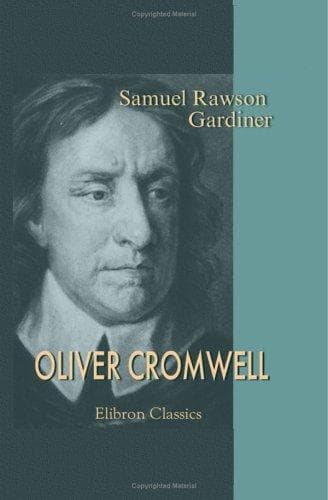
Cromwell, Oliver, 1599-1658; Great Britain -- History -- Commonwealth and Protectorate, 1649-1660
Under these circumstances the Independent party and the army split
in two. The greater number of the superior officers, together with
the Parliamentary leaders of the party, Vane, St. John and Fiennes,
supported Cromwell and Ireton in an attempt to persuade Parliament to
open the negotiations asked for by the King. As was not unnatural,
there were others, Rainsborough in the army, and Marten in the House
of Commons, who gathered round them a new Republican party, declaring
it useless to enter into a fresh discussion with Charles, and
even talking of imprisoning him in some fortress. Coalescing with
the Presbyterians, who wished merely to summon Charles to accept a
selection from the Newcastle Propositions, they beat Cromwell on the
vote, in spite of his warning that by disowning the King they were
playing into the hands of men who 'were endeavouring to have no other
power to rule but the sword'. Inside and outside the House Cromwell
was denounced as a mere time-server, who had no other end in view
but his own interests. Cromwell's only answer was to urge Charles
more pressingly than before to make the concessions without which his
restoration to any kind of authority was out of the question. Conscious
of his own integrity, he still hoped for the best, even from Charles.
"Though it may be for the present," he wrote to a friend, "a cloud may
be over our actions to those who are not acquainted with the grounds
of them, yet we doubt not God will clear our integrity and innocence
from any other ends we aim at but His glory and the public good." Yet
September passed away, and Charles had made no sign.
Charles's silence did but strengthen the party amongst the soldiers
which aimed at cutting the political knot with the sword. In the Army
Council indeed Cromwell was still predominant, and on October 6 it
agreed to meet on the 14th, to formulate terms which the King might
be able to accept. In the interval everything was done to come to a
private understanding with Charles. Charles, however, was trusting to
the probable Scottish invasion, and saw in the events taking place more
closely under his eyes no more than a chance of discrediting Cromwell
and his associates. When the Army Council met on the 14th, the subject
of continuing the negotiations had to be dropped. The position was well
explained in a letter from a Royalist. "The secret disposition," he
wrote, "is that there is no manner of agreement between the King and
the army; all this negotiation having produced no other effect but to
incline some of the chief officers not to consent to his destruction,
which I believe they will not, unless they be over-swayed; but cannot
observe that they are so truly the King's as that they will pass the
Rubicon for him, which if they could do, considering the inclination
of the common soldiers, and generally of the people they might do
what they would; but they are cold, and there is another faction of
desperate fellows as hot as fire."
Public-domain text, read in full here on John Shaqi.
Reviews
Reviews
No reviews yet
Be the first to share your thoughts on this work.
Join the Discussion
Join the discussion
Sign in to leave a comment or review.
Sign InorCreate an account