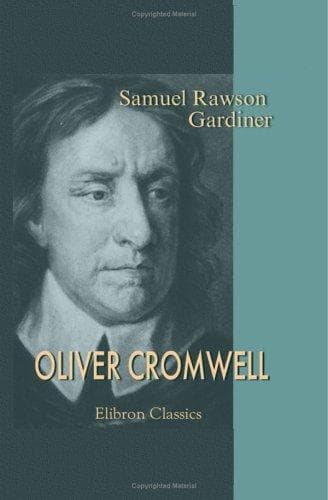
Cromwell, Oliver, 1599-1658; Great Britain -- History -- Commonwealth and Protectorate, 1649-1660
Having once given his consent to the trial, Cromwell threw himself
into the support of the resolution with all his vigour. "I tell you,"
he replied to some scruples of young Algernon Sidney on the score of
legality, "we will cut off his head with the crown upon it." When a
majority of the members of the Court refused to sit; when divisions of
opinion arose amongst those who did sit; when difficulties, in short,
of any kind arose, it was Cromwell who was ready with exhortation and
persuasion to complete the work which they had taken in hand. His
arguments appear to have been directed not to the technical point
whether Charles had levied war against the nation or not, but to
convince all who would listen that there had been a breach of trust
in his refusal to do his utmost for the preservation of the people.
Charles, on the other hand, maintained, as he was well entitled to do,
that he was not being tried by any known law, and that the violence
used against him would lead to the establishment of a military
despotism over the land. Nothing he could say availed to change the
determination of the grim masters of the hour. On January 27 sentence
of death was pronounced by Bradshaw, the President of the Court, and on
the 30th this sentence was carried into execution on a scaffold erected
in front of the Banqueting House of his own palace of Whitehall.
That Cromwell, once his mind made up, had contributed more than any
other to this result can hardly be doubted. If we are to accept a
traditional story which has much to recommend it, we have something
of a key to his state of mind. "The night after King Charles was
beheaded," we are told, "my Lord Southhampton and a friend of his got
leave to sit up by the body in the Banqueting House at Whitehall.
As they were sitting very melancholy there, about two o'clock in the
morning, they heard the tread of somebody coming very slowly upstairs.
By-and-by the door opened, and a man entered very much muffled up
in his cloak, and his face quite hid in it. He approached the body,
considered it very attentively for some time, and then shook his
head--sighed out the words, 'Cruel necessity!' He then departed in the
same slow and concealed manner as he had come. Lord Southhampton used
to say that he could not distinguish anything of his face, but that by
his voice and gait he took him to be Oliver Cromwell."
Public-domain text, read in full here on John Shaqi.
Reviews
Reviews
No reviews yet
Be the first to share your thoughts on this work.
Elsewhere in the archive
Join the Discussion
Join the discussion
Sign in to leave a comment or review.
Sign InorCreate an account