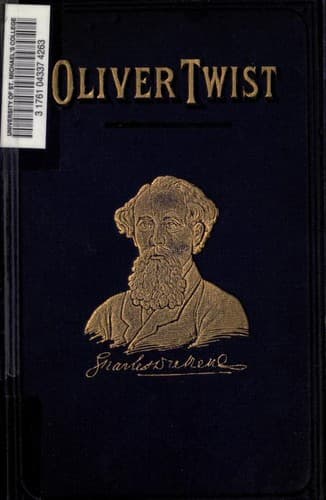
Bildungsromans; Boys -- Fiction; Criminals -- Fiction; Kidnapping victims -- Fiction; London (England) -- Fiction; Orphans -- Fiction
“_It_!” replied the woman, laying her hand over the other’s mouth. “The
only thing she had. She wanted clothes to keep her warm, and food to
eat; but she had kept it safe, and had it in her bosom. It was gold, I
tell you! Rich gold, that might have saved her life!”
“Gold!” echoed the matron, bending eagerly over the woman as she fell
back. “Go on, go on—yes—what of it? Who was the mother? When was it?”
“She charged me to keep it safe,” replied the woman with a groan, “and
trusted me as the only woman about her. I stole it in my heart when she
first showed it me hanging round her neck; and the child’s death,
perhaps, is on me besides! They would have treated him better, if they
had known it all!”
“Known what?” asked the other. “Speak!”
“The boy grew so like his mother,” said the woman, rambling on, and not
heeding the question, “that I could never forget it when I saw his
face. Poor girl! poor girl! She was so young, too! Such a gentle lamb!
Wait; there’s more to tell. I have not told you all, have I?”
“No, no,” replied the matron, inclining her head to catch the words, as
they came more faintly from the dying woman. “Be quick, or it may be
too late!”
“The mother,” said the woman, making a more violent effort than before;
“the mother, when the pains of death first came upon her, whispered in
my ear that if her baby was born alive, and thrived, the day might come
when it would not feel so much disgraced to hear its poor young mother
named. ‘And oh, kind Heaven!’ she said, folding her thin hands
together, ‘whether it be boy or girl, raise up some friends for it in
this troubled world, and take pity upon a lonely desolate child,
abandoned to its mercy!’”
“The boy’s name?” demanded the matron.
“They _called_ him Oliver,” replied the woman, feebly. “The gold I
stole was—”
“Yes, yes—what?” cried the other.
She was bending eagerly over the woman to hear her reply; but drew
back, instinctively, as she once again rose, slowly and stiffly, into a
sitting posture; then, clutching the coverlid with both hands, muttered
some indistinct sounds in her throat, and fell lifeless on the bed.
“Stone dead!” said one of the old women, hurrying in as soon as the
door was opened.
“And nothing to tell, after all,” rejoined the matron, walking
carelessly away.
The two crones, to all appearance, too busily occupied in the
preparations for their dreadful duties to make any reply, were left
alone, hovering about the body.
CHAPTER XXV.
WHEREIN THIS HISTORY REVERTS TO MR. FAGIN AND COMPANY
While these things were passing in the country workhouse, Mr. Fagin sat
in the old den—the same from which Oliver had been removed by the
girl—brooding over a dull, smoky fire. He held a pair of bellows upon
his knee, with which he had apparently been endeavouring to rouse it
into more cheerful action; but he had fallen into deep thought; and
with his arms folded on them, and his chin resting on his thumbs, fixed
his eyes, abstractedly, on the rusty bars.
Public-domain text, read in full here on John Shaqi.
Reviews
Reviews
No reviews yet
Be the first to share your thoughts on this work.
Elsewhere in the archive
Join the Discussion
Join the discussion
Sign in to leave a comment or review.
Sign InorCreate an account