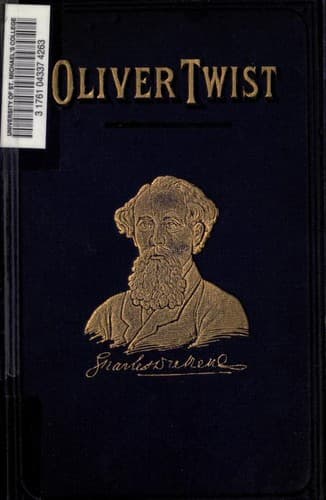
Bildungsromans; Boys -- Fiction; Criminals -- Fiction; Kidnapping victims -- Fiction; London (England) -- Fiction; Orphans -- Fiction
All this time, Mr. Giles, with the white nightcap on, had been sitting
on the steps of the chaise, supporting an elbow on each knee, and
wiping his eyes with a blue cotton pocket-handkerchief dotted with
white spots. That the honest fellow had not been feigning emotion, was
abundantly demonstrated by the very red eyes with which he regarded the
young gentleman, when he turned round and addressed him.
“I think you had better go on to my mother’s in the chaise, Giles,”
said he. “I would rather walk slowly on, so as to gain a little time
before I see her. You can say I am coming.”
“I beg your pardon, Mr. Harry,” said Giles: giving a final polish to
his ruffled countenance with the handkerchief; “but if you would leave
the postboy to say that, I should be very much obliged to you. It
wouldn’t be proper for the maids to see me in this state, sir; I should
never have any more authority with them if they did.”
“Well,” rejoined Harry Maylie, smiling, “you can do as you like. Let
him go on with the luggage, if you wish it, and do you follow with us.
Only first exchange that nightcap for some more appropriate covering,
or we shall be taken for madmen.”
Mr. Giles, reminded of his unbecoming costume, snatched off and
pocketed his nightcap; and substituted a hat, of grave and sober shape,
which he took out of the chaise. This done, the postboy drove off;
Giles, Mr. Maylie, and Oliver, followed at their leisure.
As they walked along, Oliver glanced from time to time with much
interest and curiosity at the new comer. He seemed about
five-and-twenty years of age, and was of the middle height; his
countenance was frank and handsome; and his demeanor easy and
prepossessing. Notwithstanding the difference between youth and age, he
bore so strong a likeness to the old lady, that Oliver would have had
no great difficulty in imagining their relationship, if he had not
already spoken of her as his mother.
Mrs. Maylie was anxiously waiting to receive her son when he reached
the cottage. The meeting did not take place without great emotion on
both sides.
“Mother!” whispered the young man; “why did you not write before?”
“I did,” replied Mrs. Maylie; “but, on reflection, I determined to keep
back the letter until I had heard Mr. Losberne’s opinion.”
“But why,” said the young man, “why run the chance of that occurring
which so nearly happened? If Rose had—I cannot utter that word now—if
this illness had terminated differently, how could you ever have
forgiven yourself! How could I ever have know happiness again!”
“If that _had_ been the case, Harry,” said Mrs. Maylie, “I fear your
happiness would have been effectually blighted, and that your arrival
here, a day sooner or a day later, would have been of very, very little
import.”
“And who can wonder if it be so, mother?” rejoined the young man; “or
why should I say, _if?_—It is—it is—you know it, mother—you must know
it!”
Public-domain text, read in full here on John Shaqi.
Reviews
Reviews
No reviews yet
Be the first to share your thoughts on this work.
Elsewhere in the archive
Join the Discussion
Join the discussion
Sign in to leave a comment or review.
Sign InorCreate an account