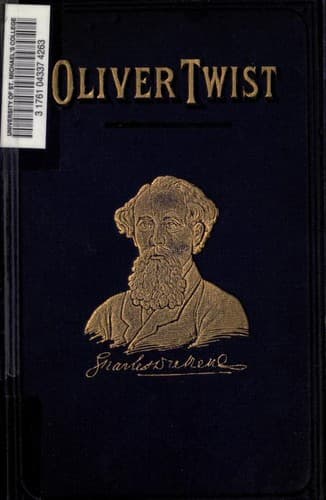
Bildungsromans; Boys -- Fiction; Criminals -- Fiction; Kidnapping victims -- Fiction; London (England) -- Fiction; Orphans -- Fiction
“I _have_ considered!” was the impatient reply; “Mother, I have
considered, years and years. I have considered, ever since I have been
capable of serious reflection. My feelings remain unchanged, as they
ever will; and why should I suffer the pain of a delay in giving them
vent, which can be productive of no earthly good? No! Before I leave
this place, Rose shall hear me.”
“She shall,” said Mrs. Maylie.
“There is something in your manner, which would almost imply that she
will hear me coldly, mother,” said the young man.
“Not coldly,” rejoined the old lady; “far from it.”
“How then?” urged the young man. “She has formed no other attachment?”
“No, indeed,” replied his mother; “you have, or I mistake, too strong a
hold on her affections already. What I would say,” resumed the old
lady, stopping her son as he was about to speak, “is this. Before you
stake your all on this chance; before you suffer yourself to be carried
to the highest point of hope; reflect for a few moments, my dear child,
on Rose’s history, and consider what effect the knowledge of her
doubtful birth may have on her decision: devoted as she is to us, with
all the intensity of her noble mind, and with that perfect sacrifice of
self which, in all matters, great or trifling, has always been her
characteristic.”
“What do you mean?”
“That I leave you to discover,” replied Mrs. Maylie. “I must go back to
her. God bless you!”
“I shall see you again tonight?” said the young man, eagerly.
“By and by,” replied the lady; “when I leave Rose.”
“You will tell her I am here?” said Harry.
“Of course,” replied Mrs. Maylie.
“And say how anxious I have been, and how much I have suffered, and how
I long to see her. You will not refuse to do this, mother?”
“No,” said the old lady; “I will tell her all.” And pressing her son’s
hand, affectionately, she hastened from the room.
Mr. Losberne and Oliver had remained at another end of the apartment
while this hurried conversation was proceeding. The former now held out
his hand to Harry Maylie; and hearty salutations were exchanged between
them. The doctor then communicated, in reply to multifarious questions
from his young friend, a precise account of his patient’s situation;
which was quite as consolatory and full of promise, as Oliver’s
statement had encouraged him to hope; and to the whole of which, Mr.
Giles, who affected to be busy about the luggage, listened with greedy
ears.
“Have you shot anything particular, lately, Giles?” inquired the
doctor, when he had concluded.
“Nothing particular, sir,” replied Mr. Giles, colouring up to the eyes.
“Nor catching any thieves, nor identifying any house-breakers?” said
the doctor.
“None at all, sir,” replied Mr. Giles, with much gravity.
“Well,” said the doctor, “I am sorry to hear it, because you do that
sort of thing admirably. Pray, how is Brittles?”
“The boy is very well, sir,” said Mr. Giles, recovering his usual tone
of patronage; “and sends his respectful duty, sir.”
Public-domain text, read in full here on John Shaqi.
Reviews
Reviews
No reviews yet
Be the first to share your thoughts on this work.
Elsewhere in the archive
Join the Discussion
Join the discussion
Sign in to leave a comment or review.
Sign InorCreate an account