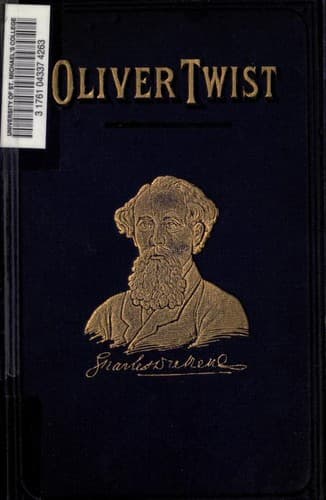
Bildungsromans; Boys -- Fiction; Criminals -- Fiction; Kidnapping victims -- Fiction; London (England) -- Fiction; Orphans -- Fiction
“My mother,” said Monks, in a louder tone, “did what a woman should
have done. She burnt this will. The letter never reached its
destination; but that, and other proofs, she kept, in case they ever
tried to lie away the blot. The girl’s father had the truth from her
with every aggravation that her violent hate—I love her for it
now—could add. Goaded by shame and dishonour he fled with his children
into a remote corner of Wales, changing his very name that his friends
might never know of his retreat; and here, no great while afterwards,
he was found dead in his bed. The girl had left her home, in secret,
some weeks before; he had searched for her, on foot, in every town and
village near; it was on the night when he returned home, assured that
she had destroyed herself, to hide her shame and his, that his old
heart broke.”
There was a short silence here, until Mr. Brownlow took up the thread
of the narrative.
“Years after this,” he said, “this man’s—Edward Leeford’s—mother came
to me. He had left her, when only eighteen; robbed her of jewels and
money; gambled, squandered, forged, and fled to London: where for two
years he had associated with the lowest outcasts. She was sinking under
a painful and incurable disease, and wished to recover him before she
died. Inquiries were set on foot, and strict searches made. They were
unavailing for a long time, but ultimately successful; and he went back
with her to France.”
“There she died,” said Monks, “after a lingering illness; and, on her
death-bed, she bequeathed these secrets to me, together with her
unquenchable and deadly hatred of all whom they involved—though she
need not have left me that, for I had inherited it long before. She
would not believe that the girl had destroyed herself, and the child
too, but was filled with the impression that a male child had been
born, and was alive. I swore to her, if ever it crossed my path, to
hunt it down; never to let it rest; to pursue it with the bitterest and
most unrelenting animosity; to vent upon it the hatred that I deeply
felt, and to spit upon the empty vaunt of that insulting will by
dragging it, if I could, to the very gallows-foot. She was right. He
came in my way at last. I began well; and, but for babbling drabs, I
would have finished as I began!”
As the villain folded his arms tight together, and muttered curses on
himself in the impotence of baffled malice, Mr. Brownlow turned to the
terrified group beside him, and explained that the Jew, who had been
his old accomplice and confidant, had a large reward for keeping Oliver
ensnared: of which some part was to be given up, in the event of his
being rescued: and that a dispute on this head had led to their visit
to the country house for the purpose of identifying him.
“The locket and ring?” said Mr. Brownlow, turning to Monks.
Public-domain text, read in full here on John Shaqi.
Reviews
Reviews
No reviews yet
Be the first to share your thoughts on this work.
Elsewhere in the archive
Join the Discussion
Join the discussion
Sign in to leave a comment or review.
Sign InorCreate an account