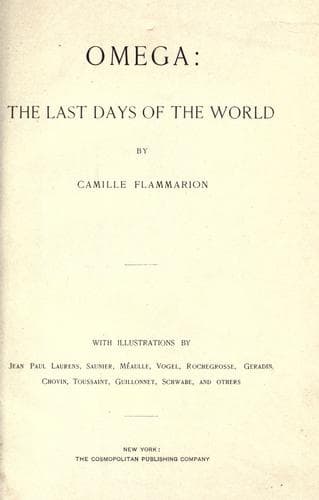
Omega: The Last days of the WorldFlammarion, Camille
Philosophy
Omega: The Last days of the World
Flammarion, Camille
End of the world -- Fiction; Science fiction
If one should remove this vapor from the surrounding atmosphere, a loss
of heat would go on at the surface similar to that which takes place in
high altitudes, for the atmosphere would then be as powerless to retain
heat as a vacuum is. A cold like that at the surface of the moon would
be the result. The soil would still receive heat directly from the sun,
but even during the daytime this heat would not be retained, and after
sunset the earth would be exposed to the glacial cold of space, which
appears to be about 273° below zero. Thus vegetable, animal and human
life would be impossible, if it had not already become so, through the
very disappearance of the water.
Certainly we may and must admit that water has not been so essential a
condition of life on all the worlds of space as it has been upon our
own. The resources of nature are not limited by human observation. There
must be, there are, in the limitless realms of space, millions and
millions of suns differing from ours, systems of worlds in which other
substances, other chemical combinations, other physical and mechanical
conditions, other environments, have produced beings absolutely unlike
ourselves, living another life, possessed of other senses, differing in
organization from ourselves far more than the fish or mollusk of the
deep sea differs from the bird or the butterfly. But we are here
studying the conditions of terrestrial life, and these conditions are
determined by the constitution of the planet itself.
[Illustration:
FOSSIL SPECIMENS OF THE XXTH. CENTURY.
]
The gradual filtration of water into the interior of the earth, keeping
pace with the radiation of the earth’s original heat into space, the
slow formation of oxides and hydrates, in about eight million years
reduced by three-fourths the quantity of water in circulation on the
earth’s surface. As a consequence of the disappearance of continental
elevations, whose débris, obeying passively the laws of gravity, were
slowly carried by the rain, the wind, and the streams to the sea, the
earth had become almost level and the seas more shallow; but as
evaporation and the formation of aqueous vapor goes on only from the
surface and does not depend upon the depth, the atmosphere was still
rich in vapor. The conditions of life upon the planet were then similar
to those we now observe on Mars; where we see that great oceans have
disappeared or have become mere inland seas of slight depth, that the
continents are vast plains, that evaporation is active, that a
considerable quantity of aqueous vapor still exists, that rains are
rare, that snows abound in the polar regions and are almost entirely
melted during the summer of each year—in short, a world still habitable
by beings analogous to those that people the earth.
Public-domain text, read in full here on John Shaqi.
Reviews
Reviews
No reviews yet
Be the first to share your thoughts on this work.
Elsewhere in the archive
Join the Discussion
Join the discussion
Sign in to leave a comment or review.
Sign InorCreate an account