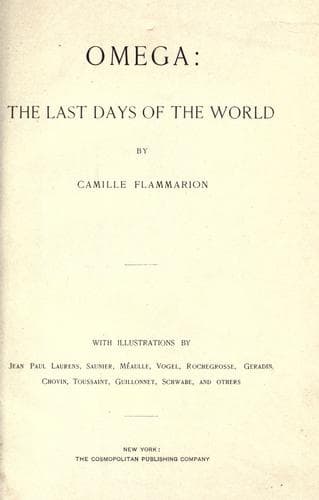
Omega: The Last days of the WorldFlammarion, Camille
Philosophy
Omega: The Last days of the World
Flammarion, Camille
End of the world -- Fiction; Science fiction
In the ruins of the other equatorial city, occupying a once submerged
valley south of the island of Ceylon, was a young girl, whose mother and
older sister had perished of consumption and cold, and who was now left
alone, the last surviving member of the last family of the race. A few
trees, of northern species, had been preserved under the spacious dome
of glass, and beneath their scanty foliage, holding the cold hands of
her mother who had died the night before, the young girl sat alone,
doomed to death in the very flower of her age. The night was cold. In
the sky above the full moon shone like a golden torch, but its yellow
rays were as cold as the silver beams of the ancient Selene. In the vast
room reigned the stillness and solitude of death, broken only by the
young girl’s breathing, which seemed to animate the silence with the
semblance of life.
[Illustration:
“ALONE!”
]
She was not weeping. Her sixteen years contained more experience and
knowledge than sixty years of the world’s prime. She knew that she was
the sole survivor of this last group of human beings, and that every
happiness, every joy and every hope had vanished forever. There was no
present, no future; only solitude and silence, the physical and moral
impossibility of life, and soon eternal sleep. She thought of the woman
of bygone days, of those who had lived the real life of humanity, of
lovers, wives and mothers, but to her red and tearless eyes appeared
only images of death; while beyond the walls of glass stretched a barren
desert, covered by the last ice and the last snow. Now her young heart
beat violently in her breast, till her slender hands could no longer
compress its tumult; and now life seemed arrested in her bosom, and
every respiration suspended. If for a moment she fell asleep, in her
dreams she played again with her laughing and care-free sister, while
her mother sung in a pure and penetrating voice the beautiful
inspirations of the last poets; and she seemed to see, once more, the
last fêtes of a brilliant society, as if reflected from the surface of
some distant mirror. Then, on awakening, these magic memories faded into
the somber reality. Alone! Alone in the world, and tomorrow death,
without having known life! To struggle against this unavoidable fate was
useless; the decree of destiny was without appeal, and there was nothing
to do but to submit, to await the inevitable end, since without food or
air organic life was impossible—or else to anticipate death and deliver
oneself at once from a joyless existence and a certain doom. She passed
into the bath-room, where the warm water was still flowing, although the
appliances which art had designed to supply the wants of life were no
longer in working order; for the last remaining servants (descendants of
ancient simian species, modified, as the human race had been, by the
changing conditions of life,) had also succumbed to the insufficiency of
water.
Public-domain text, read in full here on John Shaqi.
Reviews
Reviews
No reviews yet
Be the first to share your thoughts on this work.
Elsewhere in the archive
Join the Discussion
Join the discussion
Sign in to leave a comment or review.
Sign InorCreate an account