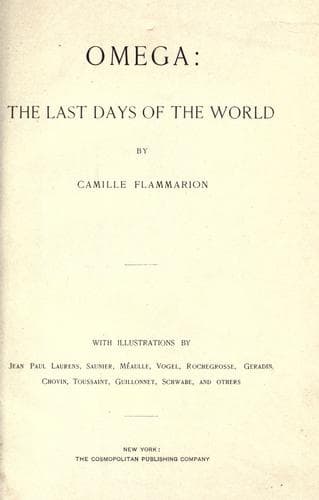
Omega: The Last days of the WorldFlammarion, Camille
Philosophy
Omega: The Last days of the World
Flammarion, Camille
End of the world -- Fiction; Science fiction
“The probable cause of the heat of the sun is the condensation of the
nebula in which this central body of our system had its origin. This
conversion of mechanical energy must have produced 28,000,000 degrees
centigrade. You know gentlemen, that a kilogram of coal, falling from an
infinite distance to the sun, would produce, by its impact, six thousand
times more heat than by its combustion. At the present rate of
radiation, this supply of heat accounts for the emission of thermal
energy for a period of 22,000,000 years, and it is probable that the sun
has been burning far longer, for there is nothing to prove that the
elements of the nebula were absolutely cold; on the contrary they
themselves were originally a source of heat. The temperature of this
great day-star does not seem to have fallen any; for its condensation is
still going on, and it may make good the loss by radiation.
Nevertheless, everything has an end. If at some future stage of
condensation the sun’s density should equal that of the earth, this
condensation would yield a fresh amount of heat sufficient to maintain
for 17,000,000 years the same temperature which now sustains terrestrial
life, and this period may be prolonged if we admit a diminution in the
rate of radiation, a fall of meteorites, or a further condensation
resulting in a density greater than that of the earth. But, however far
we put off the end, it must come at last. The suns which are
extinguished in the heavens, offer so many examples of the fate reserved
for our own luminary; and in certain years such tokens of death are
numerous.
“But in that long period of seventeen or twenty million years, or more,
who can say what the marvellous power of adaptation, which physiology
and paleontology have revealed in every variety of animal and vegetable
life, may not do for humanity, leading it, step by step, to a state of
physical and intellectual perfection as far above ours, as ours is above
that of the iguanodon, the stegosaurus and the compsognathus? Who can
say that our fossil remains will not appear to our successors as
monstrous as those of the dinosaurus? Perhaps the stability of
temperature of that future time may make it seem doubtful whether any
really intelligent race could have existed in an epoch subjected, as
ours is, to such erratic variations of temperature, to the capricious
changes of weather which characterize our seasons. And, who knows if
before that time some immense cataclysm, some general change may not
bury the past in new geological strata and inaugurate new periods,
quinquennial, sexennial, differing totally from the preceding ones?
Public-domain text, read in full here on John Shaqi.
Reviews
Reviews
No reviews yet
Be the first to share your thoughts on this work.
Elsewhere in the archive
Join the Discussion
Join the discussion
Sign in to leave a comment or review.
Sign InorCreate an account